How Long Should You Paper Trade Before Going Live?
Aug 16, 2026
Written by: Al Hill
✓ Reviewed by Kunal Vakil, Co-Founder of TradingSim · Updated Aug 17, 2026
How Long Should You Paper Trade Before Going Live?
Every new trader asks me some version of the same question: how long do I have to do this in a simulator before I can trade real money? I understand the impatience. Paper profits do not pay rent, and after a good week in the sim it is tempting to declare yourself ready. But the traders I have watched survive their first year almost never measured their practice in weeks. They measured it in trades, in market conditions, and in evidence of their own discipline. That is the framework this article lays out.
There is no fixed number of weeks that makes you ready to trade live. I tell traders to measure paper trading in completed trades and market conditions, not calendar time. As a working baseline, plan on at least 100 fully journaled simulator trades of a single setup, taken across trending, choppy, and news-driven sessions, before risking real money. For most people practicing daily in a replay simulator, that takes six to twelve weeks. Move to a live account only after you can show a written rule set, at least 20 consecutive sessions without breaking your own risk limits, and results that hold up across different market conditions rather than one hot streak. When you do switch, start at the smallest size your broker allows and expect performance to dip while you adjust to real fills and real emotions.
Calendar Time Is the Wrong Measure
Ask ten educators how long to paper trade and you will hear everything from two weeks to a year. The spread exists because the question is framed wrong. Time in the simulator is an input. What you are actually trying to buy with that time is a sample of decisions large enough, and varied enough, to tell you whether your edge is real.
Think about what a month of paper trading actually contains. If you practice only on live market hours after work, you might see 20 setups in a month, all drawn from whatever regime the market happens to be in. If those four weeks were a quiet grind higher, you have learned how your setup behaves in exactly one environment. The first high-volatility news week will hit you with conditions you have never rehearsed. You did put in the time. You just did not put in the variety.
That is why I push traders to stop asking "how many weeks" and start asking two better questions. How many trades of my specific setup have I completed and journaled? And how many distinct market conditions have those trades covered?
Count Trades and Conditions, Not Weeks
My working baseline is 100 completed, journaled trades of one setup before any of them involve real money. That number is not a law of nature. It is the point where, in my experience, patterns in your own behavior become impossible to ignore. Ten trades tell you almost nothing; a five-trade winning streak can make a coin flip look like genius. By trade 60 or 70, the journal starts confronting you with the truth: you cut winners early, you widen stops after two losses, you cannot sit still during the first fifteen minutes. Those are the findings that decide whether you survive live trading, and they only show up in a sample.
The second requirement is condition coverage. Before going live I want those trades spread across at least three environments: a trending market, a choppy range-bound market, and sessions distorted by scheduled news such as Fed announcements or earnings reactions. A setup that wins in a trend and bleeds in chop is not a bad setup. It is a setup with rules you have not finished writing, and the simulator is where you finish writing them. If you want structured ways to build that sample, I published a set of day trading practice drills that turn vague screen time into specific, repeatable exercises.
The Readiness Checklist I Actually Use
When a trader asks me whether they are ready to go live, I do not ask how long they have been practicing. I ask for evidence. A written trading plan that defines the setup, the entry trigger, the stop placement, and the maximum daily loss. A journal covering at least 100 trades of that plan. At least 20 consecutive sessions without a single violation of their own risk rules, because a rule you break in the sim, where nothing hurts, is a rule you will vaporize under real pressure. And a results curve that is at least flat-to-positive across different conditions with realistic commissions and slippage included.
Notice what is not on that list: a big paper profit. A trader who doubled a simulated account in three weeks by holding oversized positions through earnings has practiced exactly the habits that destroy live accounts. A trader who ground out a modest simulated gain while never breaking a rule has practiced the habits that keep them solvent. I will take the second trader every time. If you are still deciding what paper trading even involves under the hood, my guide to how paper trading simulators actually work covers the mechanics of fills, data feeds, and practice ledgers in detail.
How Replay Practice Compresses the Timeline
Here is the honest case for practicing in a replay simulator rather than only during live hours: the bottleneck in the framework above is repetitions, and replay removes the repetition bottleneck.
Trading live hours only, you get one open, one midday, and one close per day, and the market only shows you one regime at a time. In TradingSim, you load a real historical session, press play, and trade it tick by tick as if it were happening now. When the session ends, you load a different day. A trader with one free hour each evening can replay a fast gap-down open, then a slow grinding trend day, and journal setups from both, in the same sitting. The 100-trade sample that takes half a year of casual live-hours practice can be assembled in six to twelve weeks, and it comes pre-loaded with condition variety because you choose the days you replay. You can deliberately seek out the ugly sessions: the failed breakouts, the news reversals, the low-volume chop that punishes overtrading.
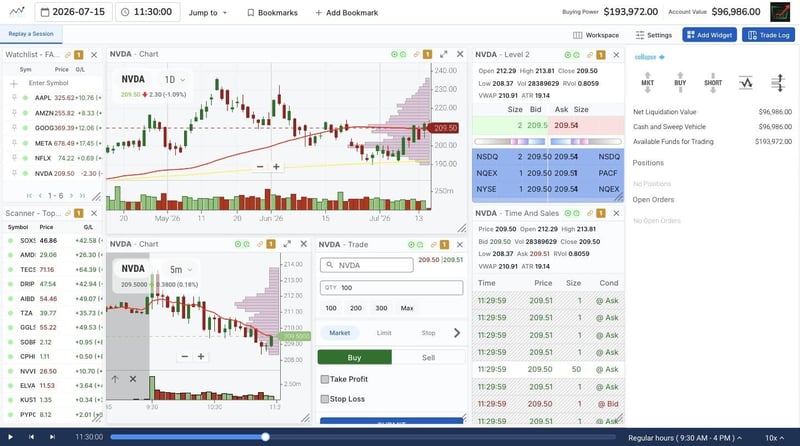
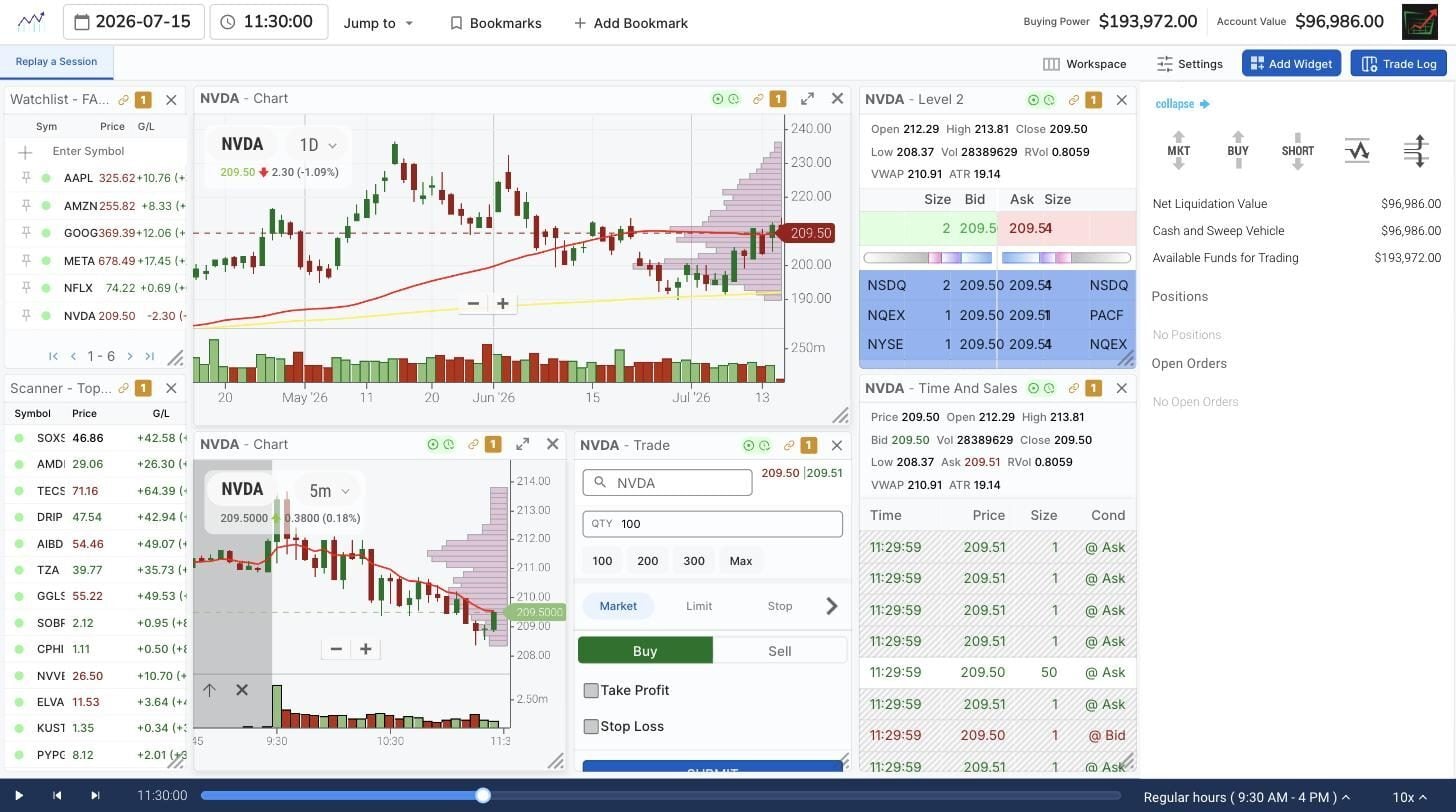
The TradingSim replay workspace on NVDA, July 15, 2026, replayed to 11:30 AM. The session opened at 212.29, tagged 213.81 in the first minutes, and sold off to 208.37 by late morning; the tape shows 209.50 bid against 209.54 offered with session VWAP at 210.91. Replay controls and speed sit on the bottom bar, so this exact morning can be traded again and again.
Replay also fixes the honesty problem in practice. Because the sessions are real recorded market data rather than a random-walk generator, the tape behaves the way tape actually behaves: liquidity thins out before news, spreads widen on the open, and support levels fail exactly as often as they failed in reality. You are rehearsing against history, not against a video game. TradingSim covers equities and futures, so the same replay discipline works whether your plan is built on stocks or on index futures contracts.
A Wyckoff Milestone Worth Adding
One more competence gate I recommend before going live, and it is the one I lean on personally: prove you can read market structure, not just your entry pattern. The Wyckoff framework gives you a vocabulary for this. Load a replayed session or a daily chart and label where accumulation ends and markup begins, where buying dries up, where distribution starts. Then scrub forward and check your work against what actually happened.
Why does this matter for the going-live decision? Because most setup failures are really context failures. A clean breakout pattern taken inside distribution fails for reasons that have nothing to do with the pattern. When a trader can consistently place their setup inside the larger Wyckoff phase before taking it, their journal stops filling up with "perfect entry, bad outcome" notes. If the framework is new to you, start with my full guide to the Wyckoff method, then make phase-labeling part of every replay session until it is automatic. I treat ten correctly labeled sessions in a row as the passing grade.
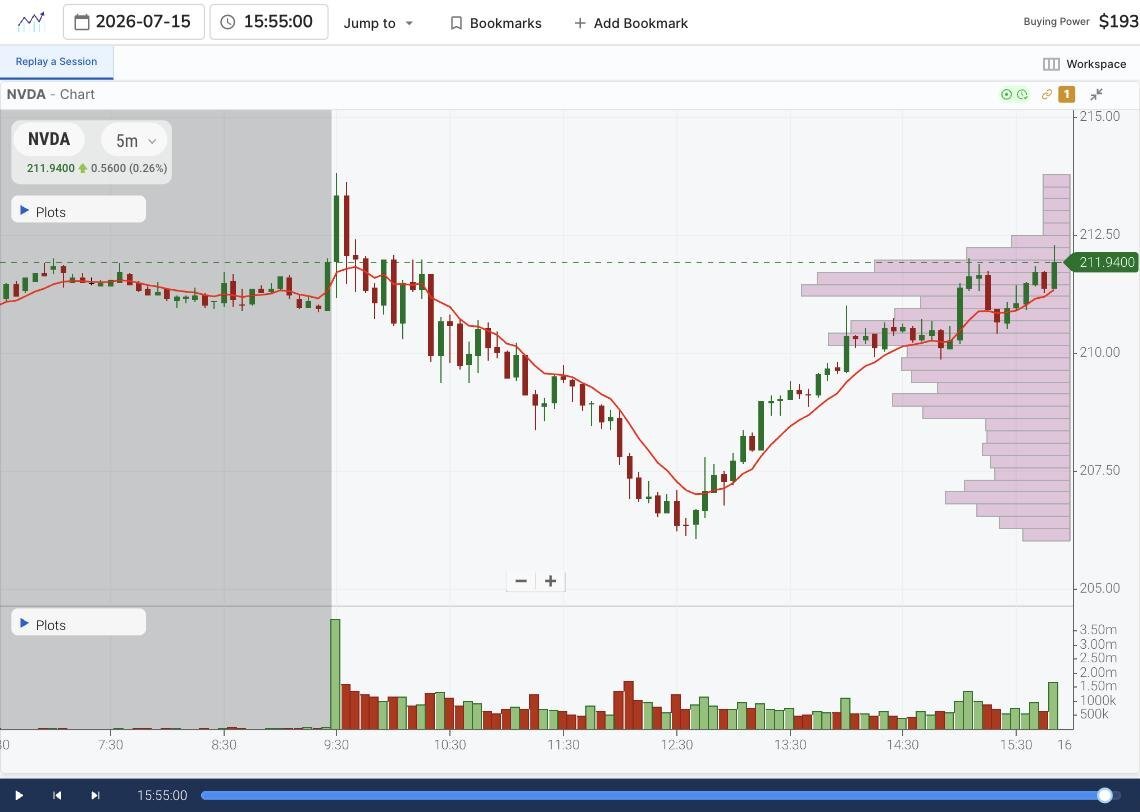
One session, every phase: NVDA 5-minute chart for July 15, 2026, replayed to 3:55 PM in TradingSim. The stock opened at 212.29, marked down to a midday low of 206.04 around 12:30, built a base, then marked up to 211.94 by the close. Sessions like this are exactly what phase-labeling practice is for: pause the replay at 12:30 and ask yourself where the markdown ended.
What Paper Trading Cannot Prove
I want to be straight about the limits, because pretending a simulator settles everything is how traders get blindsided. Paper trading cannot prove you will execute when losses are real dollars. It cannot fully reproduce slippage on thin stocks, partial fills on large orders, or the peculiar gravity a red P&L column exerts on your judgment. I wrote separately about what transfers from paper trading to live trading and about what actually changes between a simulator and a live account, so I will not repeat those arguments here. The short version: the simulator proves your system and your rule-following. Live trading with small size proves your nerves. You need both proofs, in that order.
Know the Rules Before You Fund an Account
The regulatory landscape you will step into changed this year, and most older articles still describe the old world. FINRA replaced its day trading margin provisions, including the pattern day trader rules, with new intraday margin requirements that became effective June 4, 2026, with a transition period through October 20, 2027 for firms that need more time. Under the new approach there is no $25,000 minimum equity requirement for day trading and no pattern day trader designation based on counting trades. Instead, your broker monitors that your account holds adequate equity against your open positions throughout the trading day. The minimum equity to trade with leverage at all is $2,000, maintenance margin of 25 percent of the market value of long margin-eligible equities applies intraday rather than only at the close, and repeatedly failing to satisfy intraday deficits promptly can get your margin trading restricted for up to 90 days. The details are in FINRA's own explainer on the new intraday margin requirements.
Note that during the transition window your specific broker may still be operating under the old day trading rules, so ask before you assume either regime applies to your account. And if you plan to trade a cash account instead of margin, the constraints that will actually bite are settlement and free-riding: most equity trades settle T+1, and selling a security before you have paid for it with settled funds triggers violations that can freeze your account. FINRA's primer on frequent intraday trading walks through both account types. None of this is a reason to delay going live once you have met the checklist. It is a reason to spend one evening of your paper trading period reading rules instead of charts.
The Transition Plan: Go Live Without Undoing Your Work
Graduating from the simulator is not a cliff, it is a ramp. Here is the sequence I recommend. Fund the account and trade the minimum size available: one share lots if your broker allows it, or micro contracts if your plan is built on futures. Trade exactly the setup you validated, nothing else, for at least 20 live sessions. Expect your numbers to be worse than the sim at first; real spreads, real fills, and real adrenaline all tax the edge, and the honest response is smaller size, not abandoned rules.
Keep the simulator in your routine after you go live. This is the part almost everyone skips. Live trading gives you one market per day, but your development still runs on repetitions, so use replay sessions to rehearse conditions you have not seen recently or to test rule changes before they touch real money. When something breaks in your live trading, and something will, the sim is where you diagnose it without paying tuition twice. My day trading simulator guide covers how to structure that ongoing practice, and if you are earlier in the journey and still want the foundations, start with the beginner's guide to paper trading.
So how long should you paper trade before going live? Long enough to complete a real sample: 100 journaled trades of one setup across trending, choppy, and news-driven conditions, 20 straight sessions of unbroken rules, and a plan you can hand to someone else without embarrassment. For a daily replay practice, that is usually six to twelve weeks. Traders who rush it pay the market to teach them what the simulator would have taught for free. Put in the repetitions first. The market will still be there when you are ready, and you will be much harder to shake out when you arrive.
Tags:
About the Author
Al Hill
Co-Founder & CEO, TradingSim
Alton Hill is the Co-Founder of TradingSim with over 18 years of trading experience. He completed the Design Thinking Bootcamp at Stanford’s D.School and brings expertise in Product Development to create the best trading simulation experience. His strategy focuses on trend-following systems, targeting high-volatility stocks with strong primary trends using the 15-minute chart.
Is Paper Trading Real Money? What Transfers to Live
Every few weeks someone asks me a version of the same question. They have been trading a simulator for a month, the account shows a gain, and they want to know what it means. Is paper trading real...
How to Day Trade without $25k [Updated August 2026]
For most retail traders the hurdle to begin day trading can be pretty high. One of the reasons for this is that you are limited to the number of day trades you can make if your account falls below a...
Sim Trading Habits That Actually Transfer to Live Trading
Every trader who spends time in a simulator is building habits, whether they mean to or not. The question nobody asks until they go live is which ones. Some of what you groove in replay carries...








 Day Trading Basics