Day Trading Simulator: How to Practice Trading Without Risking Real Money in 2026
Jul 19, 2026
Written by: Al Hill
✓ Reviewed by Kunal Vakil, Co-Founder of TradingSim · Updated Oct 9, 2026
Nobody gets good at trading by reading about trading. I spent my first years learning that the expensive way, and after two decades in the markets I can tell you the single biggest edge a new trader can buy is repetitions that cost nothing when they go wrong. That is the entire job of a day trading simulator.
This guide covers what a simulator actually does, why market replay beats forward-testing on a delayed feed, how the pattern day trader rule makes simulation close to mandatory for smaller accounts, and the exact way I structure practice sessions so the skills transfer to live trading instead of evaporating the first time real money is on the line.
What is a day trading simulator? A day trading simulator is software that lets you place trades against real market data without risking money. The best ones work like a flight simulator for the markets: instead of a random price generator, they replay actual historical sessions tick by tick, so you can practice the open, trade the same setup repeatedly, and review your fills, all against data the market really printed. A realistic simulator includes the full order lifecycle: market, limit, stop, and bracket orders, Level 2 depth, time and sales, and a P&L report that scores your decisions. Practicing this way separates the two problems every new trader faces, learning the craft and managing the fear, and lets you solve the first one before the second one gets a vote.
What a Day Trading Simulator Actually Does
Strip away the marketing and a simulator does three things. It feeds you market data, it accepts orders against that data, and it keeps score. The quality of each of those three legs is what separates a toy from a training tool.
On the data leg, the question to ask is whether you are trading a live delayed feed, a random walk, or true historical replay. TradingSim's replay engine covers more than 10,000 U.S. equities across Nasdaq, NYSE, and AMEX, plus futures, including the S&P e-minis and micros, and major cryptocurrencies. Pro accounts include two years of session history and Premium extends that to five, which matters more than it sounds: two years back from today still includes plenty of dull tape, and you want to practice ugly, fast markets too, not just orderly ones.
On the order leg, you should be able to simulate everything you would use live: market, limit, stop, bracket (OCO) orders, and OTO orders that attach profit targets and stops the moment you enter. If your simulator only does market orders, you are not practicing trading, you are practicing clicking.
On the scoring leg, you want per-trade breakdowns, win/loss ratios, and a P&L you can review honestly. I tell every trader I work with the same thing: a trading plan you don't score against is a wish list.
Why Practice on Replay Instead of Live Paper Trading
Most broker paper accounts, and we compare the big ones in our guide to paper trading apps and simulators, forward-test on the live feed. That means one market open per day, at 9:30 a.m. Eastern, and if you missed today's A+ setup, you wait for tomorrow. Replay removes the calendar from your learning curve.
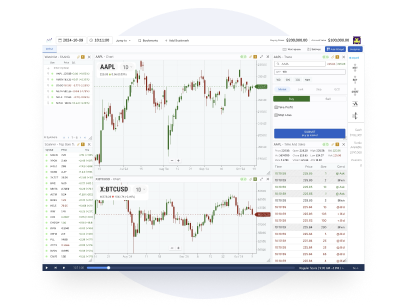
Session-based replay keeps every widget — charts, Level 2, scanner, time and sales — synchronized to the same historical moment.
Three practical consequences follow. First, repetition: you can trade the same open ten times in an evening, at 10x speed through the boring stretches, then slow to real time when the tape gets interesting. Second, coverage: you can replay pre-market and post-market sessions, which is where gappers are made and where most paper accounts are blind. If you trade the early session, our pre-market trading guide pairs naturally with replay practice. Third, time-zone freedom: the U.S. cash session runs 9:30 a.m. to 4:00 p.m. Eastern, which is evening and overnight for traders in Asia. On replay, a trader in Hong Kong can drill the New York open at their own lunchtime. Your learning schedule stops depending on the exchange's clock.
The $25,000 Question: How the PDT Rule Changes Your Practice Plan
Here is the regulatory reality that makes simulation close to mandatory for smaller accounts. Under FINRA's margin rules, you are flagged as a pattern day trader if you execute four or more day trades within five business days in a margin account, provided those trades are more than 6 percent of your total trades in that window. Once flagged, you must maintain minimum equity of $25,000 in the account on any day you day trade. Fall below it, and you cannot day trade until the account is restored to that level. Day trading in a cash account is not permitted under those same rules, and firms are free to set house minimums even higher.
We walk through the mechanics, including day-trading buying power and what happens on a margin call, in our pattern day trading rule guide. The training implication is simple: if your account is under $25,000, the market will let you take roughly three day trades a week live. Nobody learns a physical skill on three repetitions a week. The simulator is where the other two hundred repetitions come from, and it is why I push traders to figure out how much money they actually need before they rush into a live account.
How I Structure Simulator Sessions So the Skill Transfers
Random practice produces random results. When I sit down for a replay session, it has one job, one setup, and a written grade at the end. Here is the structure, and you can steal it as is.
Pick one date and one thesis before you press play. This week I loaded April 23, 2026 in replay and worked the Apple open: by 9:37 a.m. AAPL was printing 274.77 against a VWAP of 274.80, a coin-flip tape where price and VWAP are pinned together, exactly the kind of morning that punishes impatience. That is a session with a lesson in it: the drill is not trading until price actually accepts one side of VWAP. If you use VWAP in your live trading, drills like this are where the discipline gets built. The same logic applies to structural reads: if you study accumulation and distribution the way Wyckoff taught it, replay lets you scrub back and watch the same range resolve as many times as it takes for the pattern to become recognition instead of theory.
Bookmark everything worth reviewing. TradingSim lets you mark exact moments in a replay, a breakout, a failed breakout, the tick where you should have gotten out, and jump back to them later. Over weeks, those bookmarks become a private library of the market's greatest hits, organized by setup. Ten minutes reviewing bookmarks before the real open is the cheapest coaching you will ever get. The first hour of the session is where most day trading opportunity lives, so most of my bookmarks live there too.
Grade the session in writing. Not just P&L: did you take only your setup, did you size consistently, did you honor stops. Consistency on those three is the actual product of practice. The money follows it.
Reading the Tape: Level 2, Time and Sales, and Replay
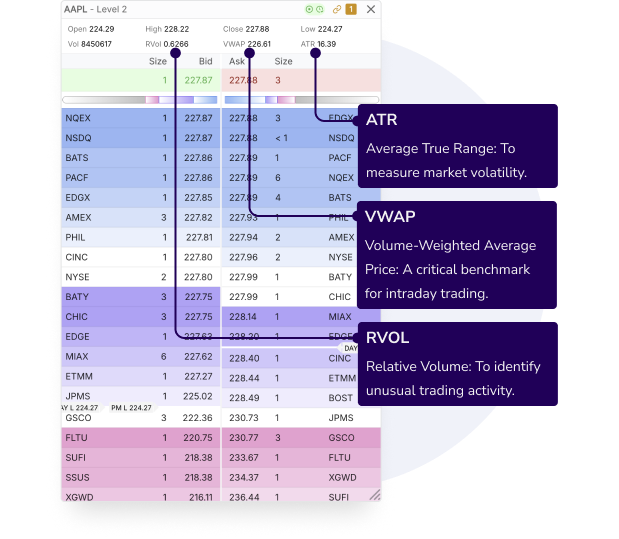
Charts tell you what happened. The tape tells you who is doing it. A serious simulator replays market depth alongside price, and TradingSim's Level 2 replay includes intraday and pre-market highs and lows, Limit Up/Down levels, and derived metrics like VWAP, ATR, and relative volume, with time and sales flagging block trades and dark pool prints.
Level 2 and time and sales replay: order-flow practice against historical liquidity, not a random number generator.
Practicing order-flow reading live is expensive, because tuition is charged per mistake. Practicing it on replay is free, and unlike a textbook, the tape never repeats itself exactly. When traders ask me where to start, my answer is unglamorous: watch the same high-volume open five times at 1x speed, calling out aloud where liquidity sits, before you place a single simulated order.
What a Realistic Simulator Must Have (and What It Costs)
Whatever platform you choose, and we keep a current comparison in our replay simulator roundup and our broader day trading software guide, hold it to this bar: true tick-level historical replay, not just delayed live data; synchronized multi-symbol, multi-timeframe charts; the full order ticket including brackets; Level 2 and time and sales; performance analytics; and enough history to practice both calm and violent markets.
On cost, I will just state ours plainly rather than bury it: TradingSim Pro is $79 a month, or $396 billed annually, and Premium is $89 a month, or $449 annually, adding five years of history, tick and second charts, Level 2, and delayed live sessions on a 15-minute feed. More than 50,000 traders have trained on the platform. Weigh any simulator's subscription against a single bad live trading week and the math is not subtle. The SEC's investor site keeps a sober primer on day trading risks that is worth reading before any money goes live; simulation is how you take those warnings seriously without taking the losses.
Simulator replay in motion: the timeline scrubber rewinds a historical session and plays it forward again — the repetition a live feed cannot give you.
Frequently Asked Questions
Is a day trading simulator free?
Some broker paper accounts are free with limitations, typically delayed data, no replay, and simplified fills. Dedicated replay simulators are paid products; TradingSim starts at $79 a month with a free trial, and the free options are compared honestly in our paper trading apps guide.
Does simulator practice actually transfer to live trading?
The mechanics transfer directly: order entry, setup recognition, tape reading. What does not transfer automatically is emotional pressure, which is why the transition should be gradual, small live size while continuing sim reps, rather than a cliff. The traders who struggle are usually the ones who treated the simulator like a game, oversizing and revenge-trading in ways they never would live.
Can I practice day trading with less than $25,000?
Yes, and that is precisely who simulators serve best. FINRA's pattern day trader rule caps traders below $25,000 in equity at three day trades per five business days in a margin account, so the simulator is where the real repetition volume has to come from.
How long should I practice on a simulator before trading live?
Measure in graded sessions, not weeks. A reasonable bar: 40 to 60 structured replay sessions on one setup, with your last 20 showing consistent rule-following, before risking a small live position. Time alone proves nothing; scored consistency does.
Alton Hill is the Co-Founder of TradingSim with over 18 years of trading experience. He completed the Design Thinking Bootcamp at Stanford’s D.School and brings expertise in Product Development to create the best trading simulation experience. His strategy focuses on trend-following systems, targeting high-volatility stocks with strong primary trends using the 15-minute chart.
The Ultimate Guide to Futures Trading Simulators: Master the Market Risk-Free [Updated August 2026]
The Reality of Trading Futures Are you struggling to gain real market experience without risking your hard-earned capital? You aren't alone. Futures trading offers high leverage and massive...
How to Day Trade without $25k [Updated August 2026]
For most retail traders the hurdle to begin day trading can be pretty high. One of the reasons for this is that you are limited to the number of day trades you can make if your account falls below a...
How Long Should You Paper Trade Before Going Live?
How Long Should You Paper Trade Before Going Live? Every new trader asks me some version of the same question: how long do I have to do this in a simulator before I can trade real money? I understand...








 Futures Trading Strategies