Paper Trading Simulator: How Practice Accounts Actually Work
Jul 27, 2026
Written by: Al Hill
✓ Reviewed by Kunal Vakil, Co-Founder of TradingSim · Updated Jul 27, 2026
The best trading month I ever had was on paper. Early in my career I ran a practice account for a quarter and it did nothing but go up, and I walked into my first live month convinced the hard part was behind me. It was not. The paper account had been filling my orders instantly, at the exact price on the screen, in whatever size I asked for. The live market did none of those things. I was not a good trader yet. I had been practicing on a machine that was rigged in my favor, and I did not find out until it cost real money.
A paper trading simulator is a practice account that lets you place trades with simulated money against real market data. The platform keeps a ledger of your fills, your positions and your profit and loss, so you get the full feedback loop of trading without the financial risk. What separates a serious simulator from a toy is the fill model. Honest ones make a market order pay the spread, make a limit order wait its turn at the price, and fill you partially when the displayed size is thin. Simulators that fill everything instantly at the last printed price are teaching a market that does not exist. The other thing to check is whether you can replay historical sessions instead of only trading live hours, because replay is what turns one free evening into a full week of practice. Trade realistic sizes, journal every entry, and review each session before you start the next one.
This guide is about the machinery. Not whether you should paper trade, but how these accounts actually work underneath: where the data comes from, how your fills get decided, the specific ways most practice accounts flatter you, and how to structure sessions so the skill transfers when money is on the line. Every screenshot is from a real replay session on our platform, with the ticker, date and levels stated so you can check them.
What a Paper Trading Account Actually Is
Strip the marketing away and a paper trading account is three components bolted together. A data feed, a fill engine, and a ledger.
The data feed supplies prices. Depending on the product, that is anything from a delayed quote refreshed every few seconds to a full tick stream with every trade and every quote change. The fill engine is the referee. It takes the order you submit and decides what you got, at what price, and when. The ledger keeps score: cash, buying power, open positions, and profit and loss marked to the current price. Our broader trading simulator guide walks through the whole category. This page stays on the practice account itself, because the differences between platforms live almost entirely in that middle component, and almost nobody talks about it.
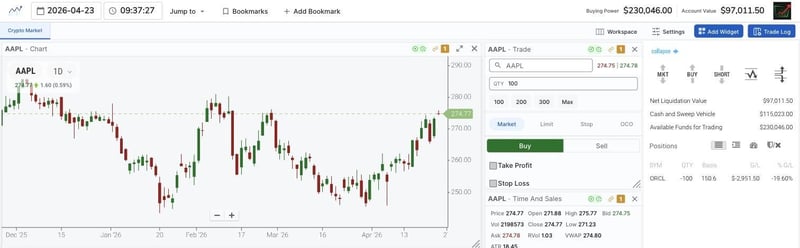
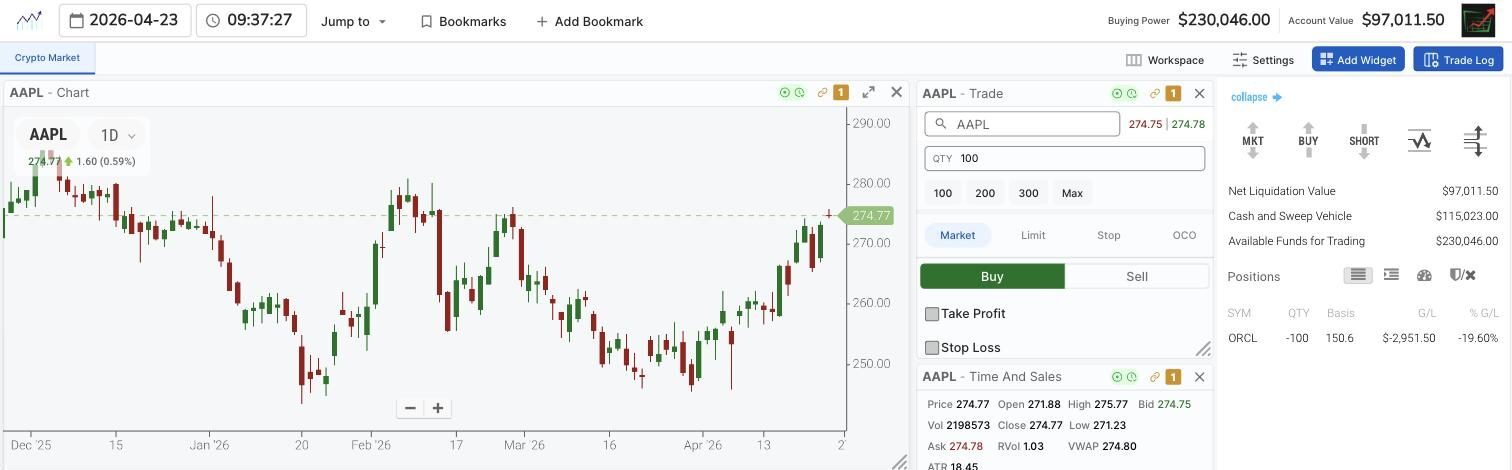
The three components in one view: data, order entry, ledger. Apple on the daily chart in a replay session dated 23 April 2026, clock at 09:37:27. Last 274.77, up 1.60 on the day, bid 274.75 against an ask of 274.78, session open 271.88, high 275.77, low 271.23, VWAP 274.80 on 2,198,573 shares. The simulated account shows 230,046 dollars of buying power against a 97,011.50 account value.
Notice what the ledger in that screenshot is doing. It is not just tracking cash. It is marking an open short position to the current price in real time, exactly the way a live account statement would. That feedback loop, position against price, updated tick by tick, is the actual product. The chart is just the window dressing.
Where the Fills Come From
When you press buy in a practice account, no order goes anywhere. There is no exchange on the other end. The platform consults its fill model and hands you a result, and the quality of that model is the difference between practice that transfers and practice that lies.
Consider what each basic order type requires the model to know. The regulator's own reference on order types is worth reading, because each one fails differently in a lazy simulation. A market order should execute near the ask when buying and near the bid when selling, which means the model needs a live bid and ask, not just a last price. A limit order should only fill when the market actually trades through your price, and even then only if there was enough volume at that level to reach your place in the queue. A stop order should trigger at your stop price and then fill like a market order, with whatever slippage the book at that moment implies.
Cheap fill models skip all of that. They fill market orders at the last print, fill limit orders the instant the price touches your level, and fill stops with zero slippage. Each shortcut deletes a cost you will pay every single time in a live account. The spread alone, paid twice per round trip, is the entire edge of many intraday strategies. A practice account that does not charge it is not simulating trading. It is simulating winning. I wrote up the equities version of this problem in detail in the stock trading simulator guide, because fragmented order books make realistic fills harder for stocks than for most other instruments.
The Ways Paper Accounts Flatter You
The instant fill is the most famous distortion, but it has quieter siblings. Most practice accounts give you unlimited liquidity, so a 5,000 share order fills as cleanly as a 100 share order, which is false in any stock that trades thin. Most give you free, always-available short inventory, when live brokers charge borrow fees on hard-to-borrow names or simply have no shares to lend. Most start you with a six or seven figure balance you did not choose, so position sizes drift far above anything you would trade with your own money. And none of them can simulate the moment a real drawdown makes your chest tighten.
Years ago I wrote a deliberately provocative piece calling out the one gigantic myth of paper trading platforms, which is the idea that a green practice account proves you are ready. It does not, and the reasons are exactly the distortions above. But the conclusion people draw from this, that paper trading is useless, is just as wrong. The fix is not to skip practice. The fix is to practice on a machine that charges you the spread, makes you wait in the queue, and lets you set the account balance to what you will actually fund, and then to treat the remaining gaps as known blind spots instead of surprises.
Live Forward or Replay: the Two Kinds of Practice
Every paper trading product runs in one of two modes, and the difference matters more than any feature list.
Live forward practice mirrors the real market as it happens. You trade the same open everyone else is trading, during market hours, once per day. The realism is perfect and the throughput is terrible. If your setup appears twice a week, you get eight repetitions a month, and only if you are free at the time they happen to occur.
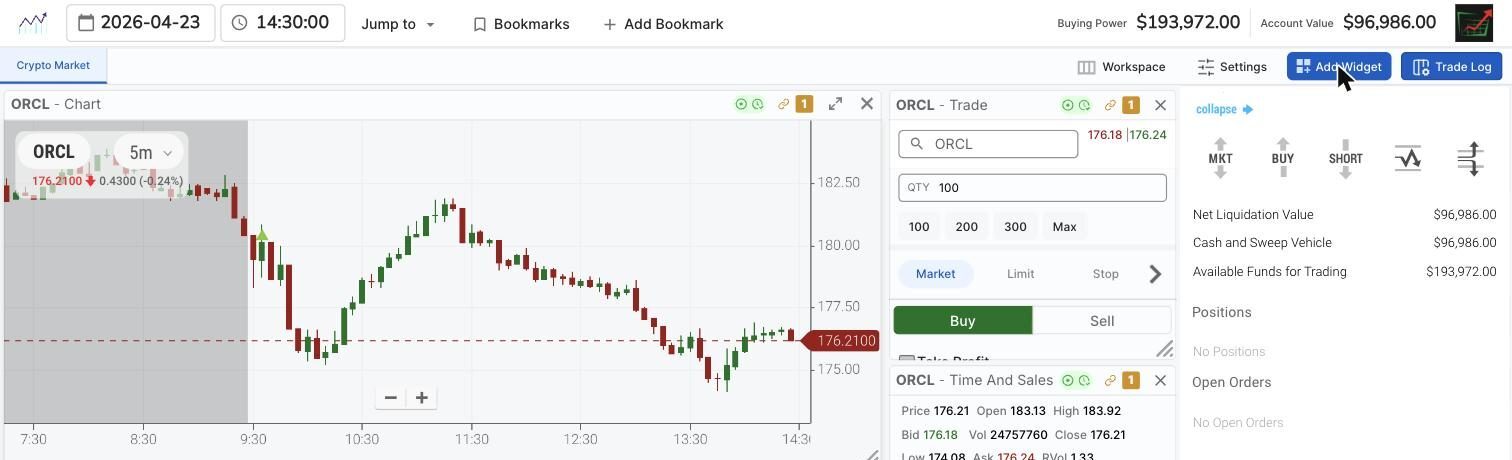
Replay practice loads a historical session and plays it forward tick by tick, with the order book and the tape reconstructed as they were on the day. You can trade the same morning five times, slow the tape down at the decision point, or run a full session at ten times speed in the evening after work. The screenshot below is what that looks like in practice: a full Oracle session replayed to mid-afternoon, scrubbed to any moment I want to re-trade.
Oracle on the 5 minute chart, replayed to 14:30 in the 23 April 2026 session. Open 183.13, high 183.92, low 174.08, last 176.21 against a VWAP of 178.11 on 24,757,760 shares, bid 176.18 and ask 176.24 at the inside. The shaded band on the left is the pre-market. The date and clock in the top corner are the replay controls, not the wall clock.
Here is the same idea in motion, a replay session running with the tape printing and orders going into the book:
Replay is the reason a practice account can compress experience. A trader limited to live hours banks one opening drive per day. A trader on replay can practice twenty of them in a week, from twenty different market days, chosen for the exact conditions they are trying to learn. That throughput argument is the spine of our day trading simulator guide, and it applies to any timeframe short enough that entries are decided in minutes.
The Psychology Gap Is Real. It Is Also Beside the Point
The standard objection to all of this is that paper trading cannot teach emotional discipline, because nothing is at stake. That is true, and anyone who tells you a simulator fully prepares you for live trading is selling something. Losing simulated money does not hurt, and the absence of pain changes behavior. People hold paper losers longer and size paper positions bigger than they ever would live.
But look at what the objection concedes. It says practice cannot teach you the last thing, managing your own nervous system with money on the line. It says nothing about the long list of things practice teaches better than live trading does: reading the tape, working orders, managing partial fills, recognizing a failed breakout in real time, executing a plan mechanically. Every one of those is cheaper to learn on simulated money, and learning them live means paying tuition in real losses for lessons a machine could have taught free. The sequence that works is boring: build mechanics in the simulator, then go live at small size to learn the emotional layer, and only then scale. Our beginner's guide to paper trading covers that on-ramp step by step.
Practicing Under the New Margin Rules
If part of your reason for practicing is to prepare for an active intraday approach, the regulatory ground moved this year, and most articles you will find are describing the old world. FINRA replaced the day trading margin framework, including the pattern day trader designation and its 25,000 dollar minimum equity requirement, with new intraday margin requirements effective June 4, 2026. There is no longer a trade-counting test in the new framework. Instead, your broker monitors whether your account holds adequate equity against your positions during the trading day, not just at the close. Fall short and you have an intraday margin deficit to satisfy promptly; make a habit of it and the account can be restricted for up to 90 days. One transition detail matters: firms have until October 20, 2027 to move over, so your specific broker may still be running the old PDT regime for a while. Ask them which one applies to you.
Cash accounts have their own mechanics worth practicing around. Equity trades settle the next business day under T+1, and FINRA's primer on frequent intraday trading is blunt about the traps: buy and sell a security before paying for it with settled funds and you are free-riding, which brings account restrictions. None of these constraints bind inside a simulator, and that is precisely why the simulator is the right place to rehearse position sizing and capital rotation as if they did. Practice with the account size and the constraint set you will actually trade under, not the defaults.
Where Wyckoff Fits in a Practice Plan
A practice account needs a curriculum, and the Wyckoff framework happens to make an unusually good one, because it turns market structure into a sequence of recognizable phases you can drill deliberately. Accumulation, markup, distribution, markdown. Each phase has characteristic price and volume behavior, and replay lets you find historical sessions where a phase played out, then trade it again and again until recognition becomes reflex.
A concrete drill: pick a name that spent weeks building a range, load the sessions around the breakout, and practice distinguishing the real move from the false one. The spring below support that reverses, the low volume test, the wide spread breakout on expanding volume. These are exactly the tells the Wyckoff method trains you to read, and they are nearly impossible to study live because you cannot schedule when the market will hand you a distribution top. On replay you can. That is the difference between waiting for the lesson and assigning it.
How to Run Paper Sessions That Transfer
Mechanics first. Set the simulated account to the balance you will actually fund, not the default. Trade the share or contract size that balance supports. Then run sessions with the same structure every time: a written plan before the session naming the setup you are hunting, the session itself, and a review after it while the decisions are still fresh.
Journal entries, not just outcomes. The question that matters in review is not whether the trade made simulated money. It is whether you took the setup you planned, at the size you planned, with the exit you planned. A profitable session full of impulse trades is a failed session. A losing session where you executed the plan cleanly is a successful one, and in a simulator the loss cost you nothing but the lesson.
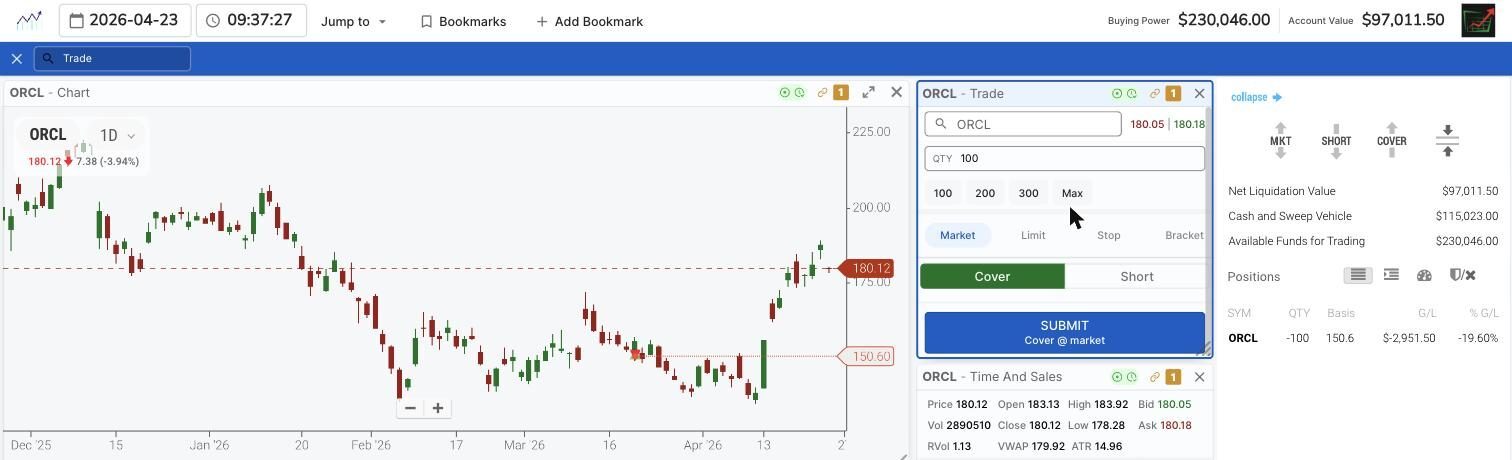
The ledger doing its job. Oracle at 180.12 on the daily chart, down 3.94 percent on the day, with the account short 100 shares from 150.60, the basis marked by the dotted line at 150.60. The platform carries the open position at a loss of 2,951.50 dollars, or 19.60 percent, and the ticket is set to cover at market. Practice accounts only teach if you let losing positions show up on the statement instead of resetting them.
One habit worth stealing from that screenshot: do not reset the account when it goes red. The short in that image is nearly thirty points underwater, and the account panel says so in plain numbers. Managing an underwater position, deciding whether the thesis is broken or the entry was early, is one of the few emotional skills a simulator can partially rehearse, and resetting the ledger every time it turns ugly throws the rehearsal away.
What TradingSim Covers, and What It Does Not
Our platform is a replay-first simulator for US equities and futures. You get historical session replay with the order book and time and sales reconstructed, variable playback speed, order tickets with market, limit, stop and bracket types, and a ledger that marks every position to the tape. The futures simulator guide covers the CME side, where contracts like the E-mini S&P trade nearly around the clock and replay works the same way.
What we do not offer: options simulation and forex simulation. If your plan is built around either of those, you want a different tool, and I would rather say so here than have you find out after signing up. If your plan is stocks or futures, the comparison worth doing is between replay-based practice and the live-forward paper accounts bundled with brokers, which I walked through in the paper trading apps guide. Broker paper accounts are free and convenient. What they cannot do is let you trade last Tuesday's open tonight, five times in a row, until the pattern is burned in.
Frequently Asked Questions
What is a paper trading simulator?
It is a practice account that lets you place trades with simulated money against market data. The platform models your fills, tracks your positions and marks your profit and loss, giving you the feedback loop of real trading without financial risk. The quality of the fill model, how it handles spreads, queues and partial fills, is what separates useful simulators from misleading ones.
Does paper trading actually work?
It works for what it can teach: order mechanics, tape reading, setup recognition and disciplined execution. It cannot teach you how you will behave with real money at risk, so treat it as the first stage of training rather than proof of readiness. Build mechanics in the simulator, then go live at small size to learn the emotional layer.
How long should I paper trade before going live?
Measure in milestones, not weeks. Move to small live size when you can state your setup in writing, execute it repeatedly in the simulator at realistic position sizes without impulse trades, and review each session against the plan. A trader who reaches that point in a month of replay sessions is better prepared than one who idles in a paper account for a year.
What is the difference between paper trading and replay trading?
Paper trading usually means practicing on the live market as it unfolds, which limits you to one session per day in real time. Replay trading plays back historical sessions tick by tick, so you can practice any past day at any hour, repeat it, and slow it down at the decision points. Replay trades throughput for a small loss of immediacy, and for skill building that trade is worth making.
Do the pattern day trader rules apply to a paper trading account?
No. Regulatory margin rules only bind real brokerage accounts. It is still worth knowing that FINRA replaced the pattern day trader framework, including the 25,000 dollar minimum, with intraday margin requirements effective June 4, 2026, with firms allowed until October 20, 2027 to transition. Practice under the constraints your real account will face so the habits carry over.
Can I practice options or forex on TradingSim?
No. TradingSim simulates US equities and futures only. There is no options simulator and no forex simulator on the platform. If you trade stocks or futures, you can replay historical sessions with the full order book and tape. For options or currency practice you will need a different product.
Tags:
About the Author
Al Hill
Co-Founder & CEO, TradingSim
Alton Hill is the Co-Founder of TradingSim with over 18 years of trading experience. He completed the Design Thinking Bootcamp at Stanford’s D.School and brings expertise in Product Development to create the best trading simulation experience. His strategy focuses on trend-following systems, targeting high-volatility stocks with strong primary trends using the 15-minute chart.
Using a Trading Simulator to Prep for a Prop Firm Evaluation
Using a Trading Simulator to Prep for a Prop Firm Evaluation Every week I hear from traders who paid for a prop firm evaluation the same day they discovered prop firms exist. Many of them fail it,...
How Long Should You Paper Trade Before Going Live?
How Long Should You Paper Trade Before Going Live? Every new trader asks me some version of the same question: how long do I have to do this in a simulator before I can trade real money? I understand...
Stock Trading Simulator: Practice With Real Market Data
The first stock I ever traded properly was a mid cap that moved about a dollar a day, and I lost money on it for a month before I worked out why. It was not the setup. The setup was fine. I was...