Every trader who puts real work into a simulator eventually asks the uncomfortable question: does any of this count? You have weeks of profitable practice sessions, and somewhere in the back of your mind a voice says the real thing will be different. The voice is right, but not in the vague way most people mean it. The differences between simulated and live trading are specific, knowable, and mostly trainable. This article walks through what actually changes when you go live, what stays surprisingly identical, and how to use each environment for what it does best.
The differences between a trading simulator and live trading fall into four buckets: execution, costs, rules, and psychology. In a simulator, your orders fill against recorded or simulated market data and the market never reacts to your order; live, your order competes with everyone else's, fills take real routing paths, and slippage is negotiated rather than modeled. Live trading adds costs and regulation a simulator does not enforce, including commissions, fees, and margin requirements that now operate under FINRA's intraday margin regime. Psychology changes most: losses cost real money, which changes behavior under pressure. What stays the same is the tape itself. A replay simulator plays back real historical sessions, so price structure, volume behavior, and setups read identically in both environments. Treat the simulator as the place to build skill through repetition, and live trading as the place to apply it with graduated size.
Execution: The Fill Is a Model in Sim, a Negotiation Live
In a simulator, the fill engine is doing you a small favor it never advertises: it fills your order against the prints that actually happened, and the market does not notice you exist. Live, the market notices. Your order leaves your platform, gets routed by your broker to an exchange, a market maker, or an ECN, and arrives at a price that may have moved while it traveled. The SEC's plain-language explainer on how orders are executed makes the point bluntly: execution is not instantaneous, quotes are only good for a specific number of shares, and by the time your order reaches the market the price can be slightly or very different.
None of that makes simulated fills useless. It means you should read them correctly: a sim fill tells you whether your idea worked at the recorded prices, not what your exact fill would have been with your order in the queue. The gap is smallest in liquid large caps trading modest size and grows with position size and volatility.
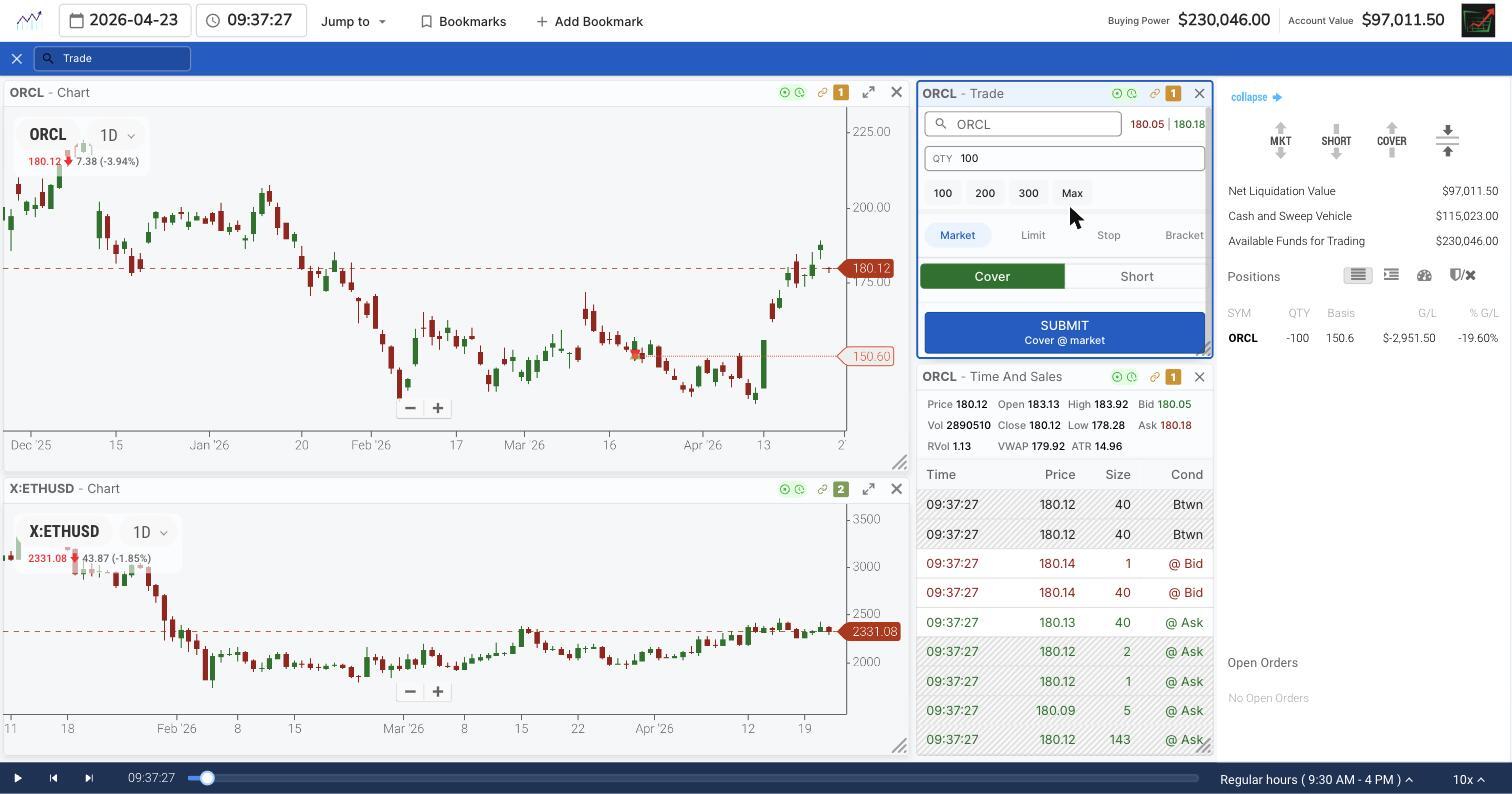
A simulated position carried to an uncomfortable place on purpose: covering a short of 100 ORCL from 150.60, marked at -$2,951.50 (-19.60%) with the stock at 180.12 during a replayed session. In a simulator you can hold a loser like this to study what it does to your decision making. Live, this position would have real consequences long before this point.
Liquidity and Slippage: What the Sim Can and Cannot Show You
A simulator can show you the Level 2 order book as it stood at any moment of a recorded session. What it cannot do is make the book react to you. When you lift an offer live, that liquidity is gone for everyone, and the next buyer pays up. When you do the same thing in replay, the tape rolls on exactly as it did historically. This is the honest structural limit of every simulator, and it matters more the bigger you trade.
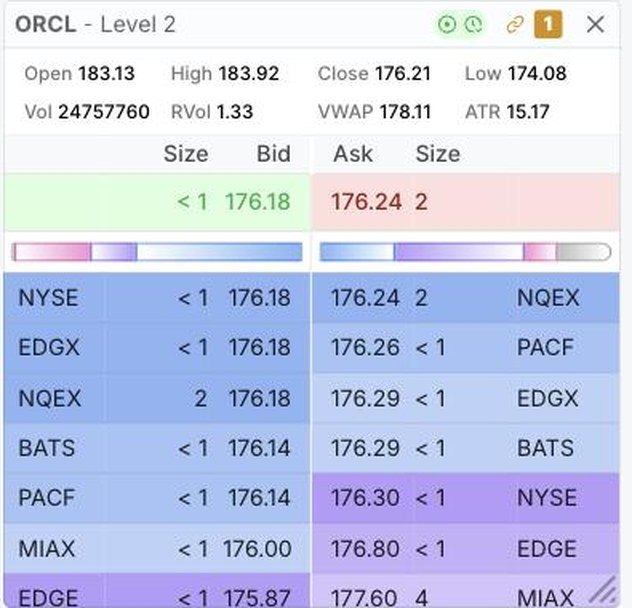
The ORCL book during the April 23, 2026 replay session: real recorded depth across NYSE, EDGX, NQEX, BATS, PACF, MIAX and EDGE, inside market 176.18 by 176.24. Reading this correctly transfers directly to live trading. Moving it does not: in replay, your order never consumes this liquidity the way it would live.
The practical adjustment is simple. In the simulator, practice at the size you actually intend to trade live, not the size that makes the practice account look impressive. A hundred shares of a liquid name behaves almost identically in both worlds. Five thousand shares of a thin small cap does not.
The Tape Itself Is the Same, and That Is the Whole Point
Here is what does not change: the market data. A replay-based trading simulator plays back sessions that actually happened, tick by tick. The failed breakout you study in replay printed exactly that way live, because it is the same session. Support and resistance, volume expansion and contraction, the structure of accumulation and distribution that Wyckoff traders map: all of it reads identically in both environments, because it is not a model of the market, it is the market, recorded.
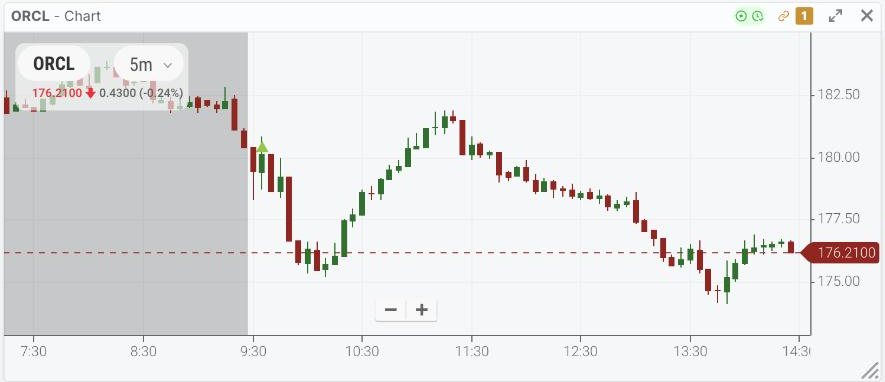
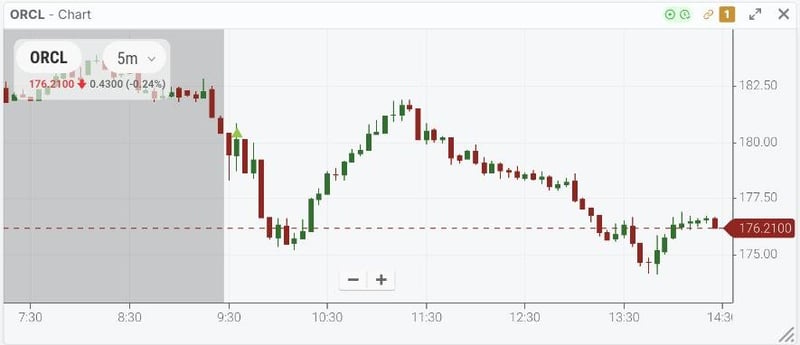
A full ORCL session on the 5-minute chart, replayed for April 23, 2026: open 183.13, high 183.92, low 174.08, close 176.21, VWAP 178.11. Every phase transition on this chart happened in the live market. That is why structural skills built in replay transfer: you are reading the same tape live traders read that day.
This is why I push back when traders dismiss simulators as fake. The fills are modeled. The tape is not. Skills that live in the tape, reading structure, timing entries, recognizing when a level fails, transfer at close to full value. Skills that live in the fill, like working large orders, transfer partially. Know which skill you are practicing.
Costs and Rules That Only Exist Live
A simulator does not charge commissions, exchange fees, or borrow fees on short positions, and it does not enforce margin regulation. Live trading does, and the rulebook just changed. Since June 4, 2026, FINRA's intraday margin requirements have been replacing the old pattern day trader framework. There is no more trade-count designation and no more $25,000 minimum tied to it. Instead, your firm monitors whether your account equity covers your positions throughout the trading day, and repeatedly failing to cover intraday deficits promptly can get your account restricted for up to 90 days. Firms have until October 20, 2027 to transition, which means your broker may be running either regime right now, and you need to know which one before you place your first live trade.
The new rules are more flexible than the old ones, and that flexibility cuts both ways. Nothing about a $2,000 account trading with intraday leverage is safer just because the $25,000 gate is gone. The discipline has to come from you, which is exactly what structured practice drills in the simulator are for.
The Psychological Gap Is Real, and Narrower Than You Fear
Real money changes behavior. Everyone says it, and it is true: the first time a live position moves against you, you will feel something no simulator produced. Traders who were patient in replay cut winners early live. Traders who honored every simulated stop start negotiating with live ones.
But notice what the gap actually is. It is not that your skills disappear. It is that pressure degrades execution of those skills, and the degradation is proportional to how automatic the skill was in the first place. A habit that survived two hundred simulated repetitions degrades a little. A habit you rehearsed twice collapses. The psychological gap is not an argument against simulation. It is an argument for more of it, at higher standards, before size ever gets involved. I covered what transfers from paper trading to live in a separate piece if you want the full breakdown.
What a Simulator Does That Live Trading Never Will
The comparison is usually framed as the simulator being a lesser version of live trading. In one dimension it is. In every other dimension it does things the live market cannot. You can replay the same session five times and trade it from five different angles. You can compress a slow afternoon into minutes, or slow a violent open down to study it. You can practice the short side, test a new setup for twenty repetitions, and blow up an account on purpose to see what a max-loss day feels like, all without spending a dollar of real capital. A live account gives you exactly one pass at each session, at real-time speed, with real consequences attached to every experiment.
That asymmetry is the entire argument for practicing in a day trading simulator before and during your live trading career, not instead of it. The traders I respect most never stopped using replay. They use it the way athletes use film and practice reps: the game is played live, but the skill is built in the rehearsal environment where repetition is cheap.
When to Make the Switch
Go live when your simulated results stop improving and your execution is boring: plans written before each session, stops honored without exception, results stable across a few weeks rather than rescued by one outlier trade. Then start at the smallest size your broker allows and treat the first month live as another drill, this time with the psychological variable switched on. Compare your live execution to your sim execution trade by trade. The difference between the two is your real curriculum for the next round of practice. Moving between environments is not a graduation ceremony. It is a loop, and the traders who improve fastest are the ones who keep running it in both directions.
Frequently Asked Questions
Is trading in a simulator the same as live trading?
No. The market data in a replay simulator is identical to what live traders saw, but fills are modeled rather than negotiated, there are no commissions or margin rules, and real money changes how you behave under pressure. The skills that live in reading the tape transfer well. The experience of risk does not fully transfer.
Why do profitable sim traders lose money live?
Three common reasons: they practiced at unrealistic size, so live slippage and fills eat the edge; they never rehearsed their process enough for it to survive pressure; or their sim profits came from a few lucky outliers rather than a repeatable process. All three are visible in advance if you review your simulated trades honestly.
Do simulators use real market data?
Replay-based simulators do. TradingSim replays historical sessions tick by tick, so the prices, volume, and order book you practice against are recordings of the real market, not a synthetic feed.
Does the $25,000 pattern day trader rule still apply to live trading?
It is being phased out. FINRA's intraday margin requirements took effect June 4, 2026, removing the pattern day trader designation and the $25,000 minimum tied to it. Firms have until October 20, 2027 to transition, so your broker may still be operating under the old rules. Confirm which regime applies to your account before going live.
How long should I trade in a simulator before going live?
Until your results are stable and your execution is automatic, not until a calendar date passes. Stable means several weeks of consistent process: written plans, honored stops, and no single trade carrying the results. Then go live at minimum size and keep using the simulator alongside live trading.