What is Day Trading Liquidity and Why It Matters [Updated July 2026]
Jul 3, 2026
Written by: Al Hill
✓ Reviewed by Kunal Vakil, Co-Founder of TradingSim · Updated Jul 4, 2026
Liquidity is a measure of how easily one can buy and sell a position in the market, and it is a very fundamental element of trading, especially day trading. There are a few steps you can take in your day trading to make liquidity nothing but a small concern.
If your account is a boat, then liquidity is the stream. When you put that boat out onto the market’s waters, you expect to be able to move and turn as you wish.
The drier the stream, the slower the boat can move. And this can be dangerous, especially for larger boats.
When day trading, you need to make sure that your boat can always float easily and cleanly without being too large for the stream.
What is Liquidity?
Aside from the boat analogies, let’s use the real estate market. Certain times of the year, people are typically looking for homes to buy. This may fluctuate depending on the season, the location, the type of home, etc.
Ideally, you want a “liquid” home if you are trying to sell it. In other words, if your home is in the right market, the right spot, at the right time, you may actually find an offer higher than your asking price! And that’s great.
Compare that to a slow market.
Nothing is moving, nothing is selling. Your location is bad, and the house might need work. You go through agent after agent trying to sell your home.
Mark down after mark down, and you finally get rid of it for a loss.
The stock market is no different. And unless you are a long term investor willing to hold out through the dry spells, you want to avoid these markets.
For day trading, this can also spell trouble if you are oversized for the amount of liquidity available that day. Here are a handful of things that could go wrong:
You won’t get filled when trying to sell limit orders.
Market orders may experience massive slippage.
You might ended up being a bag holder.
You’ll be tempted to average down to support your position.
Like trying to sell a home in a bad market, you’ll try all kinds of gimmicks and tricks to get out of your position, only to lose.
Where to Find Liquidity
Just like finding a home in an up and coming neighborhood, within a popular city, in a growing area, you want to look for stocks with the same momentum.
Though volume and liquidity are not entirely related, liquidity is still most often found in markets and stocks with the highest volume. High volume means there is significant investment and speculative interest in a market.
At any given time, you should be able to buy into and sell out of positions at will.
Along those lines, high volume stocks, bonds, exchange-traded funds or currencies will have the greatest number of market makers.
Market Makers
This is important because they are matching buyers with sellers and ensuring the market flows easily.
Exchange Traded Funds (ETFs)
Exchange-traded funds can generally be a great source of liquidity to investors.
Since an exchange-traded fund is usually a combination of stocks or commodities bundled together and sold in a package, investment banks and algorithmic trading computers help keep the price of exchange-traded funds in line with their underlying products.
In doing so, hundreds of thousands of shares are bought and sold, adding to the number of buyers and sellers, and ultimately, day trading liquidity.
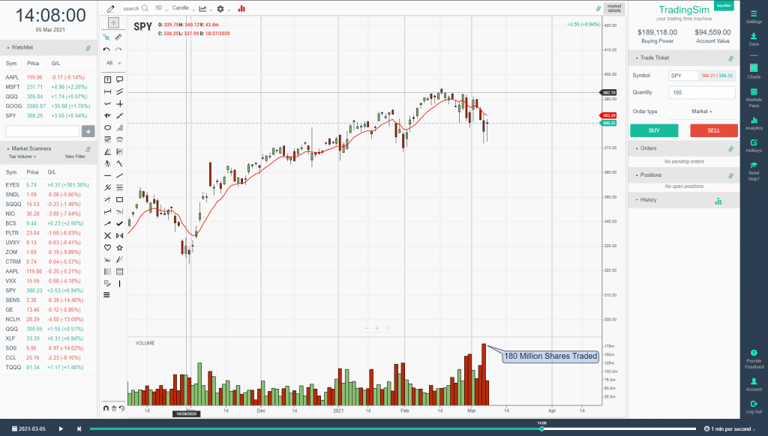
The popular SPY ETF, made to track the performance of the S&P500, generates daily volume of nearly 200 million shares.
In an eight hour trading day, that means that 25 million shares are traded per hour. This is 416,000 shares per minute or nearly 7,000 shares per second!
SPY 180 million share day.
Finding day trading liquidity here should not be an issue.
Be advised, however. There are some low volume and low liquidity exchange-traded funds. However, since these are often unprofitable for fund issuers, there are only a few on the market at any given time.
Most illiquid day trading ETFs are of the currency tracking variety.
Popular names like MSFT, AAPL, GOOG, NFLX, among others, are a haven for day trading professionals.
They attract investment banks and other institutions that trade millions of shares per day.
Often, day trading professionals will pick a few stocks and trade them exclusively.
Most often these shares are those of larger companies like the ones mentioned above, or TSLA, GE, and others.
Low Float Stock Liquidity
For the most part, low float stocks have extremely low liquidity. However, there are occasions when these lower priced, lower float stocks have “outlier” days.
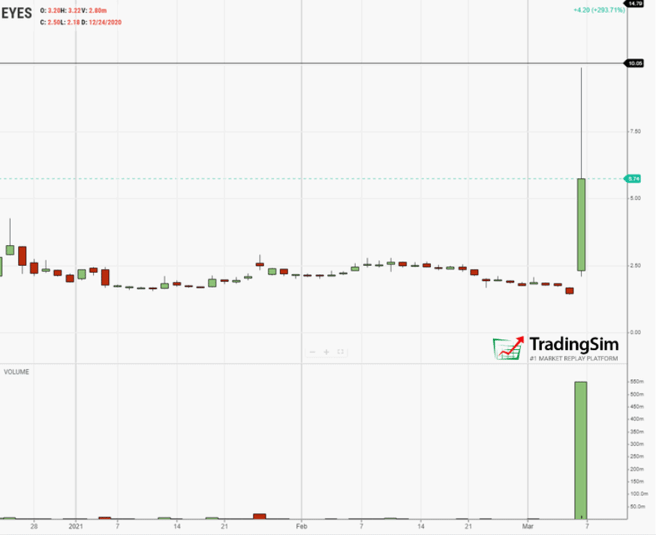
EYES “outlier” 500 million liquidity day
Like the example above, some news or event triggers an entourage of day traders chasing a fast buck. A stock like this, which was averaging only 500k shares per day, traded over 500 million in a single day.
The end result for these events can often be ugly. But for the nimble day trader, these can actually provide decent liquidity.
The currency markets often have the best liquidity, as up to $3 trillion in currencies trade hands on any one day. Plus, since the currency markets attract worldwide interest, there are far more market actors and investors to buy and sell amongst each other.
Stocks, in contrast, usually attract mostly domestic interest.
Practice Scanning for Liquidity
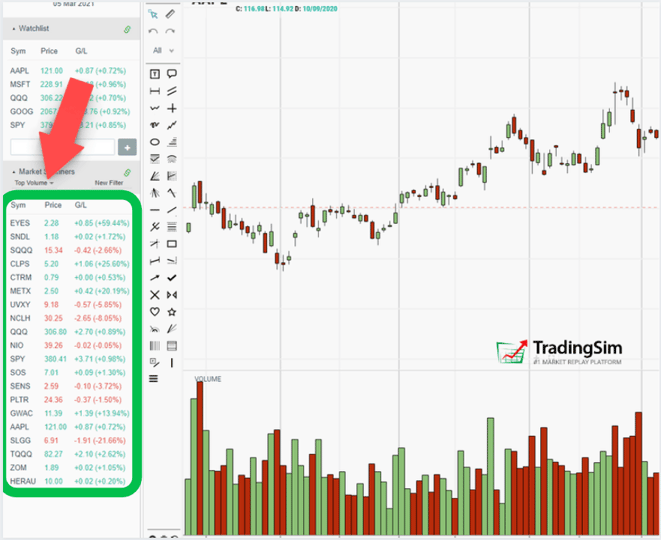
Here at TradingSim, our built-in market scanner does most of the work for you. Aside from our custom scanner, we give you the ability to scan for the top performing volume profiles on any given day.
Top Volume filter for TradingSim Scanner
This gives you an advantage while practicing your day trading strategies by filtering out any lower liquidity stocks.
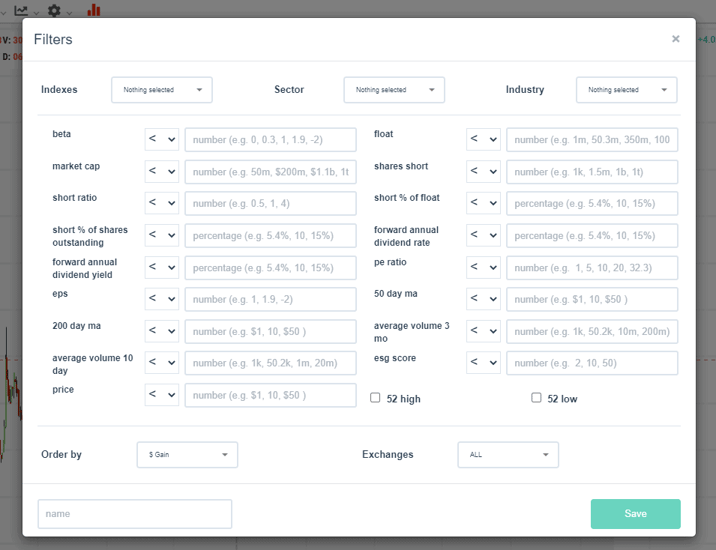
If that isn’t enough, we now offer the ability to filter your scan results by average daily volume, float, market cap, index and more!
TradingSim Scanner
Conclusion
Most traders should be able to find liquidity in the names and financial products they want to trade the most.
Since the invention of at-home and online trading, more traders have been brought into the markets. Most financial products attract enough interest to stay liquid, even little-known small caps these days.
Measuring Liquidity in 2026: A Practical Checklist
Since this guide was first published, commissions have gone to zero at most brokers, retail order flow has exploded, and off-exchange trading now handles a large share of volume. The principles above still hold — here is how to apply them in 2026:
1. Screen by dollar volume, not just share volume. A $5 stock trading 10 million shares moves $50 million; a $500 stock trading 2 million shares moves $1 billion. Dollar volume is the honest measure of how much size the market can absorb.
2. Watch the spread as a percentage. A one-cent spread on a $10 stock (0.10%) costs ten times more, relatively, than a five-cent spread on a $500 stock (0.01%). Tight percentage spreads are what make scalping viable.
3. Use relative volume (RVOL). Liquidity is dynamic. A stock trading at 5x its normal volume on a catalyst offers far better fills than the same stock on a quiet day. Most scanners let you filter for RVOL above 2.
4. Respect the open and the close. Roughly a third of the day's volume now concentrates in the first and last 30 minutes of the session. Mid-day liquidity dries up even in large caps, widening spreads and increasing slippage on market orders.
5. Test your size in a simulator. The cheapest way to learn how much size a stock can absorb is to trade it in a realistic simulator that models the spread and fills, before your real orders start moving the tape.
Related Reading
Continue building your knowledge with these TradingSim guides:
Liquidity is how easily you can buy or sell a stock without moving its price. Liquid stocks have high share volume, tight bid-ask spreads, and deep order books, so day traders can enter and exit positions quickly at prices close to what they expect.
Why does liquidity matter for day traders?
Day traders depend on fast executions and small spreads because they trade frequently and target small moves. In an illiquid stock, the spread alone can consume your profit target, and exiting a losing position can require selling into a vacuum at much worse prices.
How do you measure a stock's liquidity?
The three most practical measures are average daily share volume, the bid-ask spread as a percentage of price, and depth of book (size available at the inside quotes). Relative volume (RVOL) tells you whether today's liquidity is above or below normal for that stock.
What are the most liquid stocks and ETFs?
Major index ETFs like SPY and QQQ and mega-cap stocks such as Apple, Microsoft, Nvidia, Amazon, and Tesla routinely trade tens of millions of shares daily with penny-wide spreads, making them the most liquid instruments available to day traders.
Are low float stocks liquid?
Usually not. Low float stocks have a small number of tradable shares, so they can move violently on modest volume. They attract momentum traders precisely because of this, but liquidity can evaporate instantly, making stops unreliable and exits expensive.
Alton Hill is the Co-Founder of TradingSim with over 18 years of trading experience. He completed the Design Thinking Bootcamp at Stanford’s D.School and brings expertise in Product Development to create the best trading simulation experience. His strategy focuses on trend-following systems, targeting high-volatility stocks with strong primary trends using the 15-minute chart.
Wheat Futures – 7 Things to Consider Before Trading
Wheat Futures Wheat is a grain that that is cultivated and consumed worldwide, making it one of the staple foods in the world that spans across continents and generations. Wheat is a primary...
Day trading scans are an integral part to any day trading strategy. How else will you know what to trade? Yet, in a universe of thousands of stocks, finding the best candidates each morning can be a...
Trading Simulator vs Live Trading: What Actually Changes
Every trader who puts real work into a simulator eventually asks the uncomfortable question: does any of this count? You have weeks of profitable practice sessions, and somewhere in the back of your...









 Commodity Futures