The Ultimate Guide to Futures Trading Simulators: Master the Market Risk-Free [Updated August 2026]
Aug 16, 2026
Written by: John McDowell
✓ Reviewed by Al Hill, Co-Founder of TradingSim · Updated Aug 17, 2026
The Reality of Trading Futures
Are you struggling to gain real market experience without risking your hard-earned capital? You aren't alone. Futures trading offers high leverage and massive potential, but the learning curve is steep—and expensive. Most traders blow up their first account within 90 days because they are practicing with real money in a market that takes no prisoners.
TL;DR — Futures Trading Simulator
A futures trading simulator lets you trade real historical or live market data without risking capital. The two main engine types are replay-based (you scroll through historical tick data and trade as if live) and live-paper (you trade real-time data with simulated fills). Replay-based simulators are better for skill development; live-paper is better for testing live system performance.
Replay engine: tick-by-tick playback of historical sessions; you can pause, rewind, and re-trade specific events (e.g., FOMC, earnings, Oct 2008 capitulation).
Live-paper engine: real-time market data with simulated fills; better for testing automation latency and order routing but you cannot rewind.
Micro futures support: MES, MNQ, M2K, MCL — smaller contracts that match real-world risk control for sub-$10k accounts.
Capital-free learning: futures simulators bypass the Pattern Day Trader rule entirely since futures are not regulated as securities.
Skill compounding: 50–100 hours of replay practice is roughly equivalent to 6–12 months of real-time screen time for pattern recognition.
A futures trading simulator is the bridge between losing money and consistent profitability. But not all simulators are created equal.
This article explores how these tools provide a risk-free environment to practice strategies, analyze volatility, and build confidence. We will cover the critical difference between standard "paper trading" and "market replay," and why dedicated platforms like Tradingsim are the secret weapon for serious day traders looking to get funded.
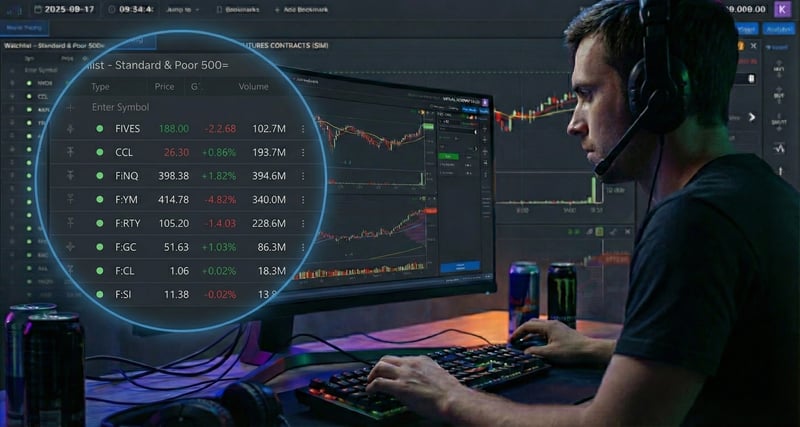
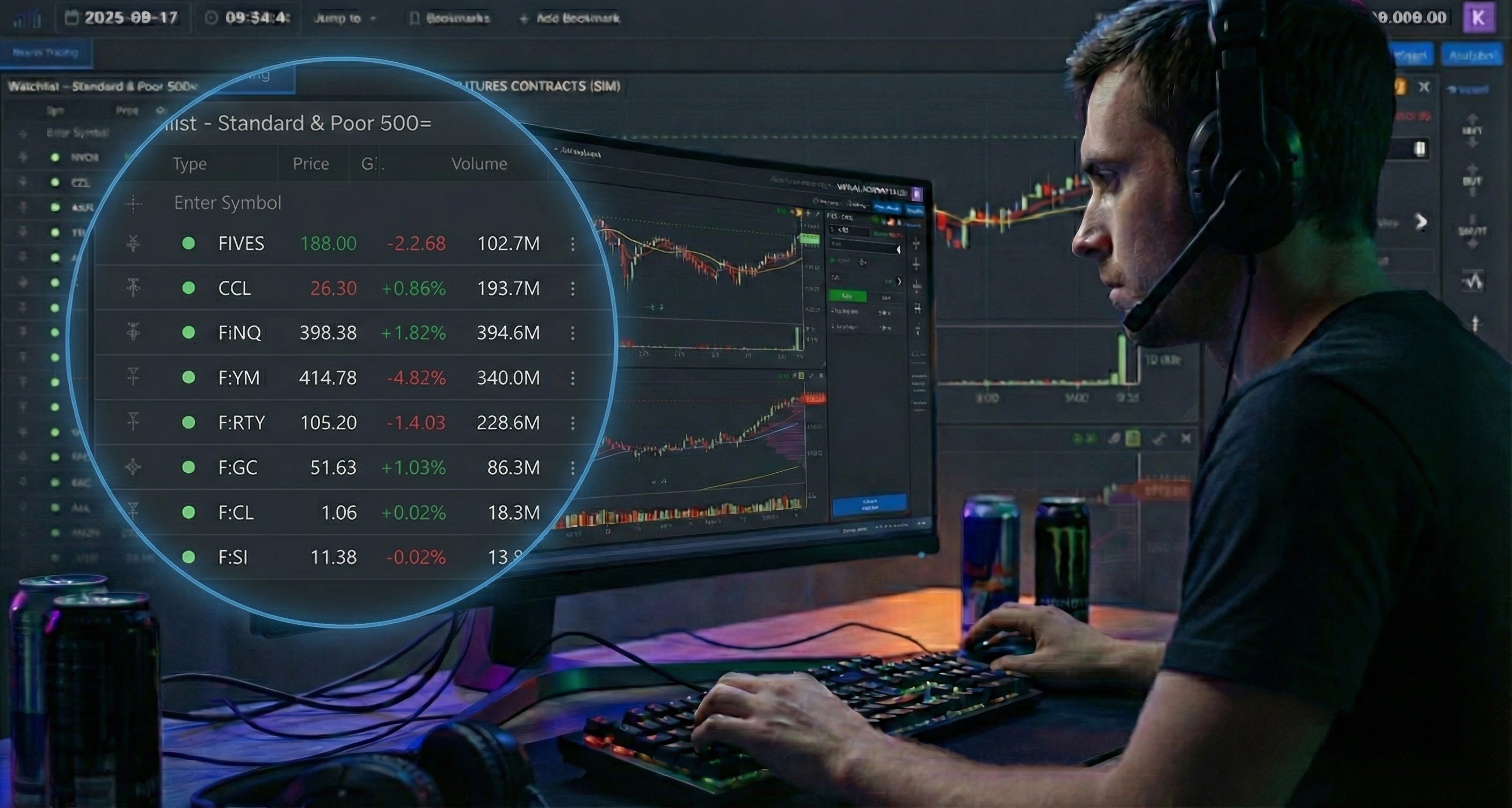
A futures trading simulator is a sophisticated software tool that replicates the dynamics of real futures markets (like the CME, NYMEX, or ICE).It allows users to practice trading assets such as the E-mini S&P 500 (ES), Nasdaq 100 (NQ), Crude Oil (CL), and Gold (GC) without financial risk.
Unlike a static chart, a simulator mimics the live environment—including order execution, margin requirements, tick values, and price volatility—allowing you to test your edge before the opening bell rings.
The "Paper Trading" Trap
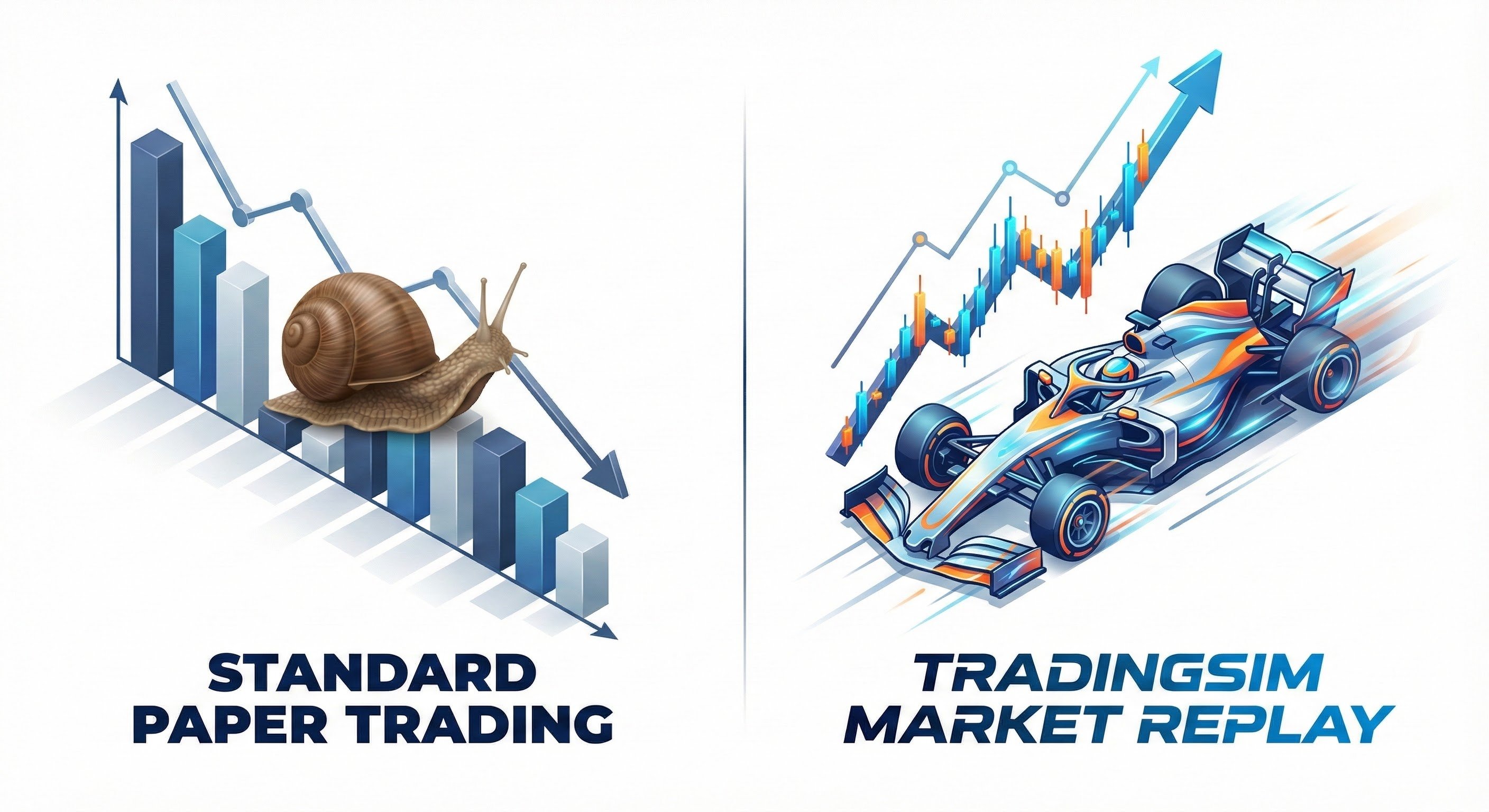
Most beginners confuse Paper Trading with Market Replay. Understanding this distinction is the difference between taking 2 years to learn to trade and taking 3 months.
1. Standard Paper Trading (The "Waiting Game")
Platforms like Thinkorswim, Webull, or Interactive Brokers offer paper trading. This is simply a demo account connected to the live market feed.
The Problem: You are bound by real-time. If you want to practice trading the market open (9:30 AM EST), you must be physically present at 9:30 AM EST. If the market is chopping sideways for 4 hours, you have to sit there for 4 hours to see what happens.
The Result: Your learning curve is slow because you are limited to one trading session per day.
2. Market Replay (The "Time Machine")
This is what Tradingsim offers. Market Replay allows you to access years of historical tick-by-tick data and replay it as if it were live.
The Advantage: You can trade the "Market Open" 10 times in a single hour. You can fast-forward through the boring chopped periods and rewind to replay a specific breakout setup until you master it.
The Result: You can practice 2 years' worth of trading data in a single weekend. This is "deep practice," similar to how a pro athlete watches game tape.
Part 2: Feature Showdown – Tradingsim vs. The Rest
To demonstrate the distinction between other simulators and Tradingsim, consider this comparison grid.
Comparison Grid: Tradingsim vs. Broker Simulators
Feature
Tradingsim
Thinkorswim (Paper)
Webull (Paper)
Topstep (Practice)
Data Type
Historical Tick-by-Tick (2+ Years)
Live Stream Only
Live Stream Only
Live Stream Only
Market Replay
Yes (24/7 Access)
No (OnDemand is clunky)
No
No
Weekend Practice
Yes (Trade anytime)
No (Markets are closed)
No
No
Fast Forward
Yes (Skip the chop)
No
No
No
Risk Analytics
Advanced (P&L, Drawdown, Win%)
Basic
Basic
Basic
Setup Time
Instant (Web-based)
High (Software Install)
Medium
High
Cost
Fixed Monthly/Annual
Free (Requires Account)
Free
$150+/mo (Evaluation)
The Verdict: Broker simulators are fine for learning how to click "Buy" and "Sell." Tradingsim is for learning how to make money.
Part 3: Why Futures Traders Need a Specialized Simulator
Futures are different from stocks. They are highly leveraged, move based on different catalysts (macroeconomic data), and have specific "personalities." A generic stock simulator won't cut it.
1. Understanding Contract Specifications
In Tradingsim, you aren't just trading a ticker; you are trading the contract. You learn the "tick value" of every instrument:
ES (S&P 500): $12.50 per tick. A 4-point move is $200 per contract.
NQ (Nasdaq 100): $5.00 per tick. A highly volatile beast that can rip 50 points in seconds.
CL (Crude Oil): $10.00 per tick. Known for technical precision and respect for support/resistance.
GC (Gold): $10.00 per tick. Driven by fear, inflation, and the US Dollar.
Practicing on a simulator teaches you to respect the leverage. A 10-point loss on the NQ with 1 contract is $200. With 10 contracts, it's $2,000. You need to feel that pain in the simulator before you feel it in your bank account.
2. Native Indicators for Futures
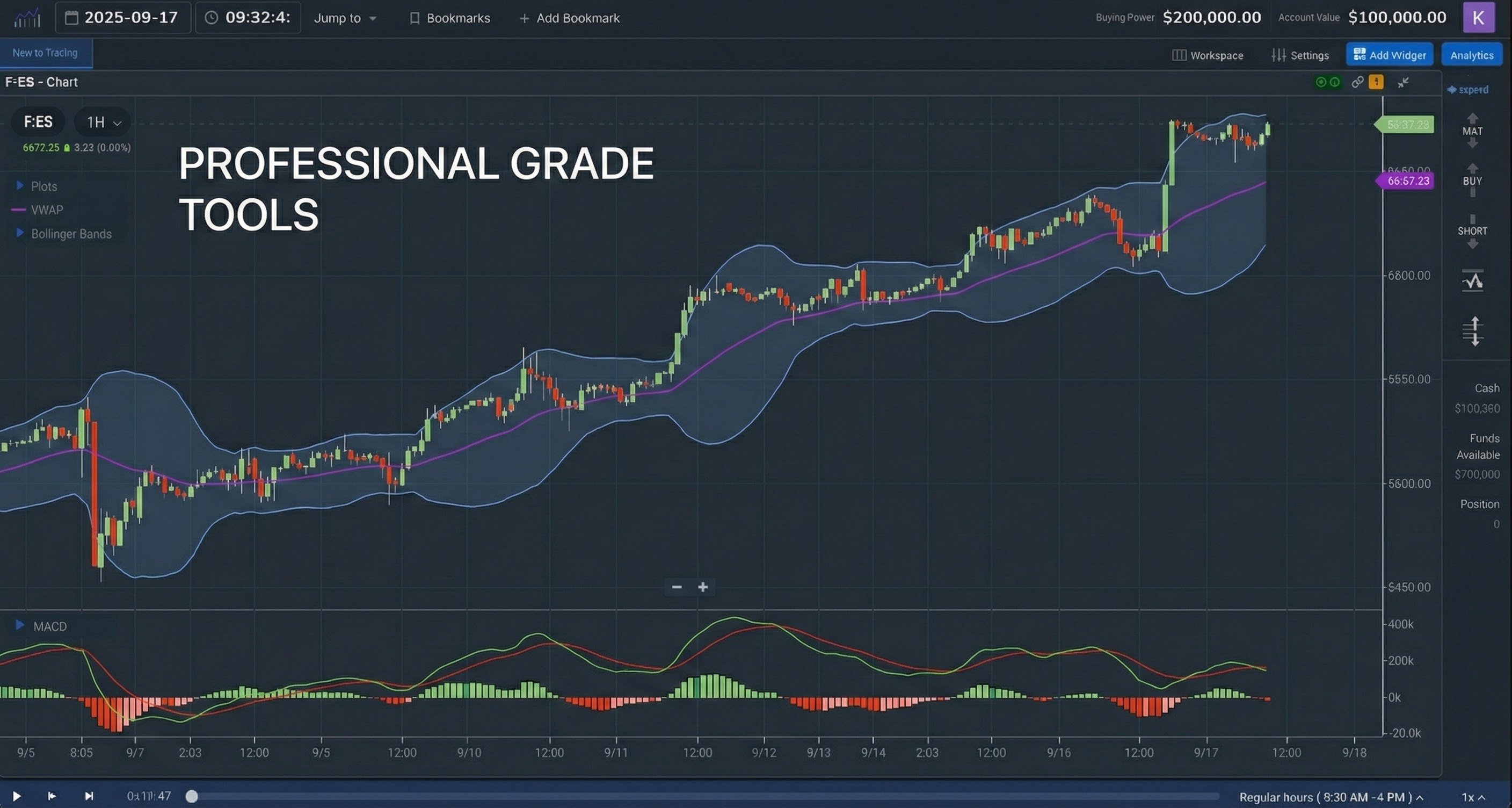
Futures traders rely on specific tools. Tradingsim includes the heavy hitters:
VWAP (Volume Weighted Average Price): The holy grail for institutional futures traders.
Pivot Points: Floor trader pivots that algo bots still respect today.
Part 4: The "Prop Firm" Shortcut – How to Get Funded
This is the biggest trend in 2025. "Prop Firms" like Topstep, Apex Trader Funding, and MyFunded Futures will give you capital (e.g., $50,000 to $150,000 buying power) to trade if you can pass their evaluation.
The Catch: You have to follow strict rules.
Profit Target: Usually $3,000 - $9,000 depending on account size.
Daily Loss Limit: You cannot lose more than $1,000 in a day.
Trailing Drawdown: You cannot lose money from your peak balance.
How Tradingsim Helps You Pass
Most traders fail these evaluations because they pay $150/month to take the test before they are ready. They use the evaluation as practice. This is burning money.
The Smart Strategy:
Simulate the Combine: Use Tradingsim to set up a "mock combine."
Enforce the Rules: Tell yourself, "If I lose $1,000 in my Tradingsim account today, I am done."
Practice the Specific Hours: Prop firms often restrict trading during major news events. Use Tradingsim's replay to practice trading around 8:30 AM CPI data releases to see how volatile the slippage can be.
💡 Pro Tip:
Do not pay for a Topstep combine until you have passed it 3 times in a row on Tradingsim. This discipline alone will save you thousands of dollars in reset fees.
Part 5: Strategies for Effective Practice
To get the most out of a simulator, you must treat the fake money as real. Here are three specific drills you can run in Tradingsim today.
Drill 1: The "Opening Range Breakout" (ORB)
This is a classic futures strategy.
The Setup: Load up the Nasdaq 100 (NQ).
The Process: Wait for the first 15 minutes of the market open (9:30 AM - 9:45 AM).
The Trigger: Draw a line at the High and Low of that 15-minute range. If price breaks above the high, buy. If it breaks below the low, sell.
The Replay: Replay the last 30 days of market opens. How many times did this work? Did it fake out?
The Lesson: You will learn that NQ often has a "fake-out" before the real move. You can only learn this nuance by seeing it 50 times in a row.
Drill 2: The "Trend Pullback"
The Setup: Load Crude Oil (CL).
The Indicator: Turn on the 20-period Moving Average (20MA).
The Process: Fast forward until you see a clear trend (price is consistently above the 20MA).
The Trigger: Wait for price to touch the 20MA. Enter long. Place your stop below the previous candle low.
The Replay: Practice managing the trade. Do you sell at the first pop? Or do you trail your stop?
Drill 3: The "Disaster Day" Management
The Setup: Pick a day in history known for massive crashes (e.g., March 2020, or a recent CPI release).
The Goal: Survival.
The Drill: Try to trade this volatility without blowing up your account.
The Lesson: You will learn that sometimes the best trade is no trade. Seeing the speed of a crash in a simulator inoculates you against the fear when it happens live.
Part 6: Developing the Trader's Mindset (Psychology)
A simulator can teach you mechanics, but can it teach you psychology? Yes, if you use it correctly.
The "Simulated Emotion" Technique
The reason demo trading often fails is the lack of emotional "pain." To fix this, you must attach consequences to your simulation.
The Rule: "If I violate my rules in Tradingsim (e.g., moving a stop loss), I am not allowed to watch Netflix tonight." or "I must do 50 pushups."
The Effect: By attaching a real-world annoyance to a virtual mistake, you begin to wire your brain to respect the risk.
Overcoming FOMO (Fear Of Missing Out)
In live markets, when you see a green candle ripping up, you feel the urge to chase it.
Tradingsim Solution: Use the Rewind button. When you miss a move in the simulator, pause. Rewind. Look at the chart before the move happened. Was there a signal? Or was it random?
Often, you'll realize there was no signal, and chasing it would have been gambling. This builds the discipline to let random moves go.
Part 7: Transitioning to Live Markets
The ultimate goal of a simulator is to graduate. You are ready to transition to live futures trading when you meet these benchmarks:
The 100-Trade Sample: You have executed 100 trades in Tradingsim using one specific strategy.
The Profit Factor: Your gross profits divided by gross losses is greater than 1.5.
The Drawdown Test: You have experienced a losing streak (everyone does) and did not change your strategy or increase your position size to "make it back."
The "Micro" Step
When you go live, do not jump straight to the E-mini (ES). Start with the Micro E-mini (MES).
ES: $50 per point
MES: $5 per point. The chart is the same. The data is the same. But the risk is 1/10th. Use your Tradingsim strategies on the Micros for 3 months. If you are profitable there, then scale up.
Conclusion
Futures trading simulators are the flight simulators of the financial world. You wouldn't trust a pilot who learned to fly solely by reading a book; you shouldn't trust yourself with your savings until you've logged your flight hours.
They prepare you for the turbulence of the live market without the crash. Whether you are looking to trade the E-mini, scalp the Nasdaq, or position trade Crude Oil, starting with a platform like Tradingsim ensures you build the necessary skills to navigate volatility and secure your edge.
Stop playing games with "paper trading" apps. Start building a career with Market Replay.
This video is relevant because it provides a visual walkthrough of passing a Topstep combine, reinforcing the specific "Prop Firm" strategies discussed in the blog post.
Replay-Based vs Live-Paper Simulators: Which Engine for Which Job
The single most important decision when picking a futures simulator is the engine type. They are not equivalent.
Replay-Based Simulator
A replay engine streams historical tick data through the platform as if it were live. You can pause at any bar, rewind, fast-forward, or re-trade the same session multiple times. The benefit: compressed learning. You can practice 50 FOMC sessions in a weekend without waiting 50 months for them to happen.
The drawback: replay does not test automation latency, order routing, or your broker's actual fill quality. It tests you, not your tech stack.
Best use cases for replay: pattern recognition practice, strategy backtesting with discretion, drilling specific event types (CPI prints, earnings reactions, capitulation sessions), building day trading fundamentals.
Live-Paper Simulator
A live-paper engine connects to real-time market data and simulates fills against current bid/ask. You trade in real time without risking capital. The benefit: realistic timing — you experience the actual feel of order entry under live market pressure.
The drawback: you can only trade what is happening right now. Want to practice a major reversal? You wait for one. Want to test your strategy in a low-volatility tape? You wait for that, too. Practice density is lower than replay.
Best use cases for live-paper: testing a finished strategy before going live, evaluating broker fill quality, training discipline during slow sessions.
The Pro Workflow
Use replay for skill development, then validate with live-paper before risking real money. Most professional traders cycle between the two: replay for deliberate practice on weekends, live-paper during the week to test ideas in current conditions.
Why Futures Simulation Beats Stock Paper Trading for Most Traders
Futures and stocks both have simulators, but the asymmetry favors futures for skill-building reasons.
No PDT rule. Futures are regulated as commodities, not securities. The $25,000 Pattern Day Trader rule does not apply. You can unlimited day-trade in a futures simulator and then transition to a small live account without restriction.
Micro contracts. MES (Micro E-mini S&P 500) requires ~$500 of day-trade margin per contract. MNQ (Micro Nasdaq) is similar. This means the live transition from sim is gradual — you can size your first real trades at the same risk as your sim trades.
One product, deep liquidity. Trading ES futures means you spend all your screen time on one symbol, mastering its rhythm. Compare that to scanning 5,000 stocks — you spread your pattern recognition thin.
Tax efficiency. Section 1256 60/40 treatment means 60% of futures gains are long-term capital gains regardless of holding period. The day trading taxes guide covers the math — for active traders, this can save 10–15 percentage points annually.
This is why traders starting with under $25k often pick futures over stocks. The how to day trade without $25k guide details the workarounds for stock traders, but futures sidestep the problem entirely.
5 Features That Actually Matter in a Futures Simulator
Most reviews compare simulators on cosmetics. These are the features that affect skill transfer and risk control.
1. Tick-by-Tick Replay (Not Just OHLC Replay)
OHLC replay shows you the bar open, high, low, close — not the sequence. Tick-by-tick shows you the actual path price took inside the bar. The difference matters because most decisions are made intrabar — you need to see how price reached the high, not just that it did.
2. Realistic Fill Logic
Cheap simulators give you perfect fills at the exact price you clicked. Real markets don't. Look for simulators that model slippage on stops, partial fills on illiquid contracts, and queue position on limit orders.
If you cannot practice on MES, MNQ, M2K, and MCL, you cannot practice at the same risk level you'll trade live. Most realistic transition path: sim with micros, go live with micros, scale to e-minis only after consistent profitability.
4. Trade Journaling Built In
Manual journaling is the #1 abandoned habit in trading. Built-in journaling that captures entry, exit, chart screenshot, and notes automatically removes the friction. Pair it with a trading journal template to review patterns weekly.
5. Replay of Specific Historical Events
The 2008 financial crisis, COVID March 2020, FOMC days, CPI prints, the GME and AMC squeezes — these are the sessions you want to drill. A simulator that gives you direct access to these events is dramatically more valuable than one that only does generic random replay.
How to Structure 90 Days of Simulator Practice
Most beginners use simulators randomly — they trade, lose interest, quit. Here is a structured 90-day plan that produces measurable skill growth.
Days 1–30: Pattern recognition. Pick one product (MES or MNQ). Open a daily chart. Mark every instance of a specific pattern (e.g., doji at support, bull flag breakout) over the last 12 months. Trade each one in replay. Track win rate.
Days 31–60: Setup execution. Switch to intraday charts. Trade the same patterns live (in sim) during your actual screen-time hours. Use a strict trading journal to capture every decision.
Days 61–90: Risk management. Add position sizing, stop placement, and partial profit-taking rules. Aim for consistency, not size. The goal at day 90: a documented edge with a positive expectancy and a survivor's risk profile.
This is how TradingSim users report consistent skill improvement. The replay engine compresses time; the structured plan compresses the learning curve.
Size the Sim Like the Account You Will Actually Trade
The most common way traders waste months of simulator practice is not a bad strategy — it is trading size in the sim that they will never trade live. A trader with $8,000 in real capital who practices five ES contracts is not practicing. They are playing a video game with a different risk model, and every habit they build will have to be unlearned on day one of live trading.
Position size changes behavior more than any other variable. It determines how long you can sit in an adverse move, whether you take the scratch exit, and how you feel when the trade goes against you. Practice at the wrong size and you are rehearsing decisions you will never face.
The Sizing Math
Work backwards from the account you will fund, not the account you wish you had:
Set your per-trade risk first. Most traders cap risk at 1% of account equity per trade. On a $10,000 account that is $100.
Convert to ticks. One ES tick is $12.50; one MES tick is $1.25. If your stop is 8 ticks, one ES contract risks $100 — the entire budget. One MES contract risks $10.
Size to fit, not to feel busy. If the math says one micro contract, practice one micro contract. Trading ten in the sim because it is free teaches you nothing transferable.
This is exactly why micro futures contracts matter so much for the transition from simulator to live. Micros let the sizing you practiced survive contact with a real account, so the step from replay to live capital is a change in consequence, not a change in strategy.
Log the Size, Not Just the Result
Record contract count alongside every simulated trade in your trading journal. When you review a losing week, the question is rarely “was the setup wrong?” It is usually “was I sized in a way that let me hold the setup long enough to work?” You cannot answer that without the size on the record.
One more piece the sim cannot teach you: the tax treatment is different too. Futures fall under Section 1256 with its 60/40 split, which changes the after-tax value of a given strategy versus equities — worth understanding before you scale, and covered in our day trading taxes guide.
Frequently Asked Questions
What is a futures trading simulator?
A futures trading simulator is software that lets you trade real historical or live futures market data without risking capital. The two main engine types are replay-based (historical tick playback you can pause and rewind) and live-paper (real-time data with simulated fills).
Is futures simulator trading worth it?
Yes — for skill development, simulator practice is one of the highest-ROI uses of time for new traders. 50–100 hours of focused simulator practice compresses what would take 6–12 months of real-time screen exposure. The key is structured practice, not random clicking.
What is the best futures simulator for beginners?
Look for three features: (1) tick-by-tick replay (not just OHLC), (2) micro futures support (MES, MNQ, M2K), and (3) realistic fill logic with slippage modeling. Replay-based simulators are generally better for beginners because they let you drill specific patterns repeatedly.
Can you make real money from a futures simulator?
No — simulators use virtual money. Their value is skill development and strategy testing. The transition path is: prove consistent profitability in sim → fund a live account with micro contracts → scale up only after maintaining the same metrics live.
How long should I practice on a simulator before going live?
Most experienced traders recommend at least 90 days of structured practice with a documented edge and positive expectancy before risking real capital. Some traders take 6–12 months. The threshold is consistency, not time — if your sim equity curve trends up across 90 days, you have evidence of an edge worth testing live.
Related Trading Resources
Continue your trading education with these related guides from TradingSim:
John McDowell is the Lead Content Strategist at TradingSim. His journey into day trading began in 2016 after conversations with a retired hedge fund manager. John is passionate about teaching and educating traders, curating content that helps others succeed in the stock market.
The Best Stock Simulators with Replay in 2022 – Which is the Best?
In this post, we’ll discuss the best stock simulators that allow you to replay markets in order to study in your free time. We’ll cover the pros and cons of each, and best practices for how to use...
Best Stock Trading Simulators for Beginners [Updated September 2026] Stock trading simulators serve a unique purpose in the world of trading and investing. While not always popular, they provide the...
Day Trading Demystified: A Comprehensive Guide to Using Demo Accounts [Updated July 2026]
Beginner’s Guide to Day Trading in Demo Accounts So you want to be a day trader, huh? Alright. Well, your work is cut out for you. Chances are you've seen SMCI on the news lately, going from around...







 day trading simulator