Futures Trading Basics: Contracts, Margin, and Ticks
Oct 17, 2026
Written by: Al Hill
✓ Reviewed by Kunal Vakil, Co-Founder of TradingSim · Updated Oct 17, 2026
Futures Trading Basics: Contracts, Margin, and Ticks
Most traders meet futures the way you meet a cold pool, one toe at a time, and the vocabulary is what keeps them on the ladder. Multipliers, ticks, initial margin, maintenance margin, quarterly expirations. None of it is hard, but all of it is unfamiliar, and unfamiliar plus leveraged is a combination that empties accounts. So this guide does one job: it walks through the three ideas that every futures trade is built on, the contract, the margin, and the tick, using real numbers from the exchange that lists these products and real screens from replayed sessions. By the end you should be able to look at any futures quote and answer the only question that matters before an entry: what does being wrong by one point cost me here? Everything else in futures trading is a refinement of that answer.
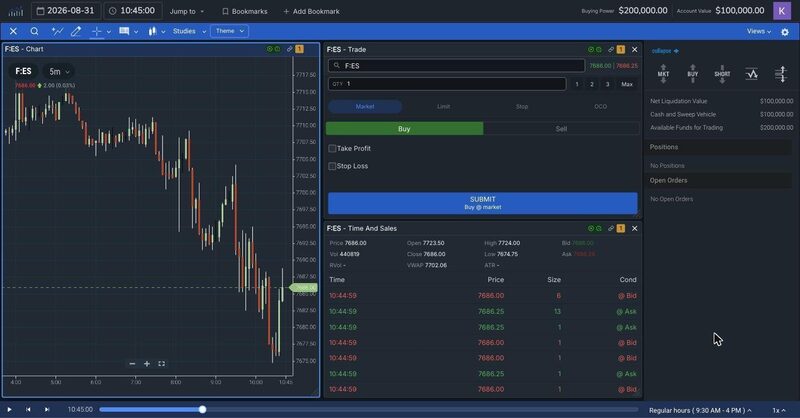
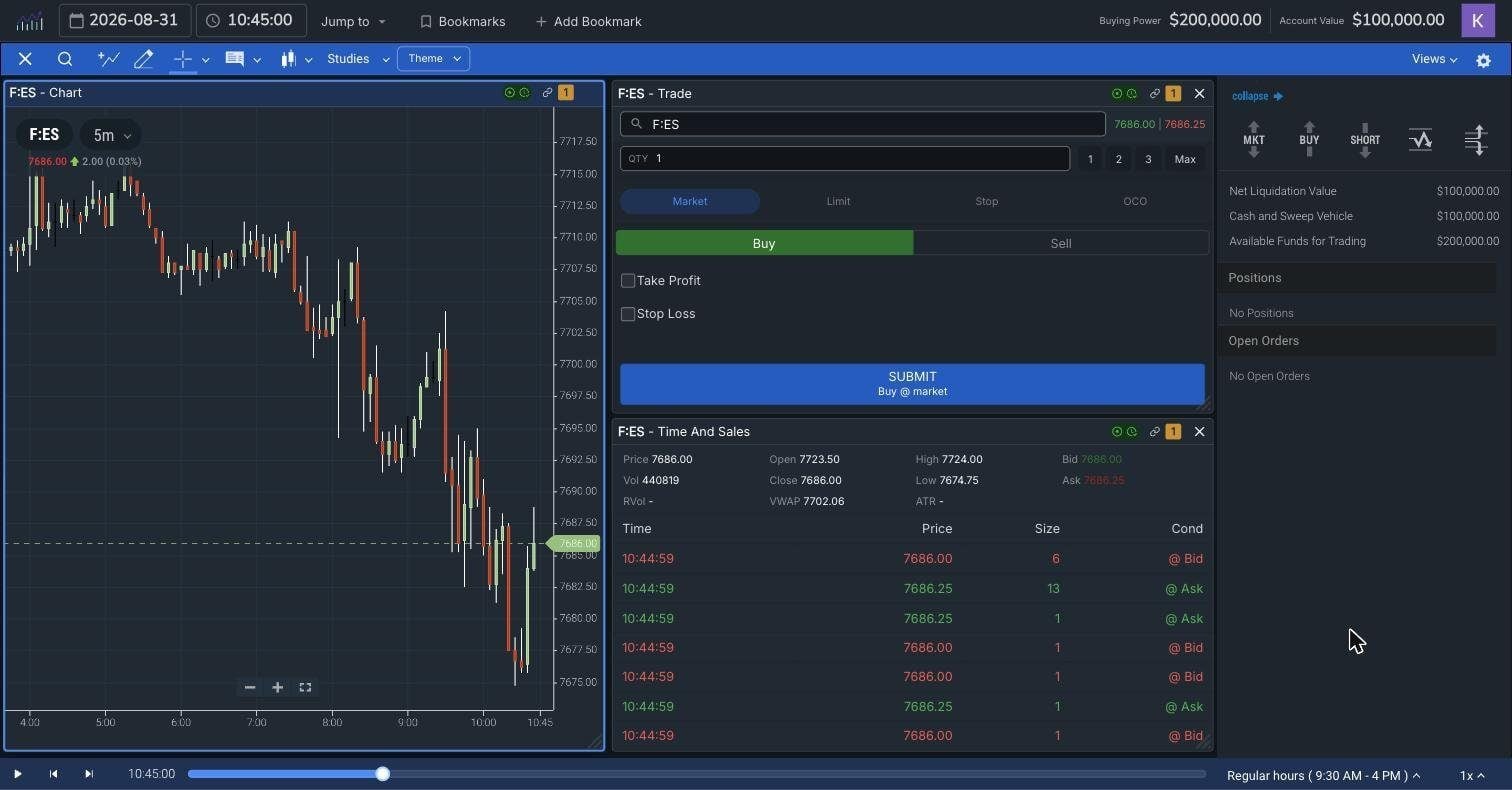
A futures session replaying in TradingSim: the E-mini S&P 500 (F:ES) on August 31, 2026 at 10:45 a.m. ET. The session opened at 7,723.50, has marked down to a 7,674.75 low, and prints 7,686.00 against a 7,702.06 VWAP on 440,819 contracts, with a one-lot market ticket and Time and Sales beside the 5-minute chart. Every term in this article is visible somewhere on this screen.
Futures trading basics come down to three numbers. A futures contract is a legally binding agreement to buy or sell a standardized asset on a set date, traded on an exchange and centrally cleared. Its multiplier converts points into dollars: the E-mini S&P 500 is $50 per index point, the Micro E-mini $5. The tick is the smallest increment the price can move, 0.25 points on the S&P contracts, worth $12.50 on ES and $1.25 on MES. Margin is a deposit held with your broker while a position is open, not a down payment: CME Clearing sets initial and maintenance levels, typically 3 to 12 percent of the contract's notional value, and an account that falls below maintenance faces a margin call or liquidation. Learn those three numbers for one contract, then rehearse full sessions in a replay simulator before any of it is live.
What a Futures Contract Actually Is
Strip away the screens and a futures contract is a promise with a date on it. CME Group's own course material defines it as a legally binding agreement to buy or sell a standardized asset on a specific date or during a specific month, facilitated through a futures exchange. The word doing the work there is standardized. You and I never negotiate what one E-mini S&P 500 contract contains; the exchange fixed that, which is why a buyer in Chicago and a seller in Singapore can trade it in milliseconds without reading anything. Every contract is also centrally cleared, meaning the clearinghouse stands between buyer and seller and guarantees the trade, so you never think about who is on the other side. And despite the delivery language, delivery is rare in practice. The CFTC's futures basics page notes that most contracts are liquidated before the delivery date and some settle in cash instead. Day traders close the same day; nobody is parking an index in your driveway. I go deeper on contract specifications in my day trader guide to futures contracts, but for basics, hold onto this: standardized terms, exchange traded, centrally cleared, almost always closed before expiry.
The Multiplier Turns Points Into Dollars
Here is where futures stop resembling stocks. A share of stock is worth its price. A futures contract is worth its price times a multiplier, and the multiplier is where beginners get hurt. Per CME Group's Micro E-mini FAQ, the E-mini S&P 500 (ES) carries a $50 multiplier and its Micro counterpart (MES) carries $5, exactly one tenth the size. On the Nasdaq-100, NQ is $20 per point and MNQ is $2. So a ten-point move in the S&P 500 index, the kind of move that happens while you refill your coffee, is $500 per contract on ES and $50 on MES. Same index, same chart, same prints, a tenfold difference in consequence. This is why I tell new traders the multiplier is the first thing you learn about any contract, before the chart, before the strategy. If you cannot say from memory what one point is worth in the contract you are about to trade, you have not chosen a position size, you have guessed one. Which micro to start with is its own decision, and I have written up the shortlist in best futures to trade for beginners and the fuller comparison in micros versus minis.
Ticks: The Smallest Move on the Board
Futures prices do not move continuously. They move on a grid, and the grid spacing is the tick, the minimum price fluctuation the exchange allows. On the S&P 500 contracts that spacing is 0.25 index points. CME's FAQ prices the MES tick at $1.25, and since tick increments follow the E-mini counterparts, the same 0.25-point move on ES at its $50 multiplier is $12.50. On the Nasdaq micros, a 0.25-point MNQ tick is worth $0.50. Ticks matter because they are the honest unit of trading. Your stop is not really four points; it is sixteen ticks, and sixteen ticks on ES is $200 per contract. Price your trades in ticks and the dollar risk stops being a surprise.
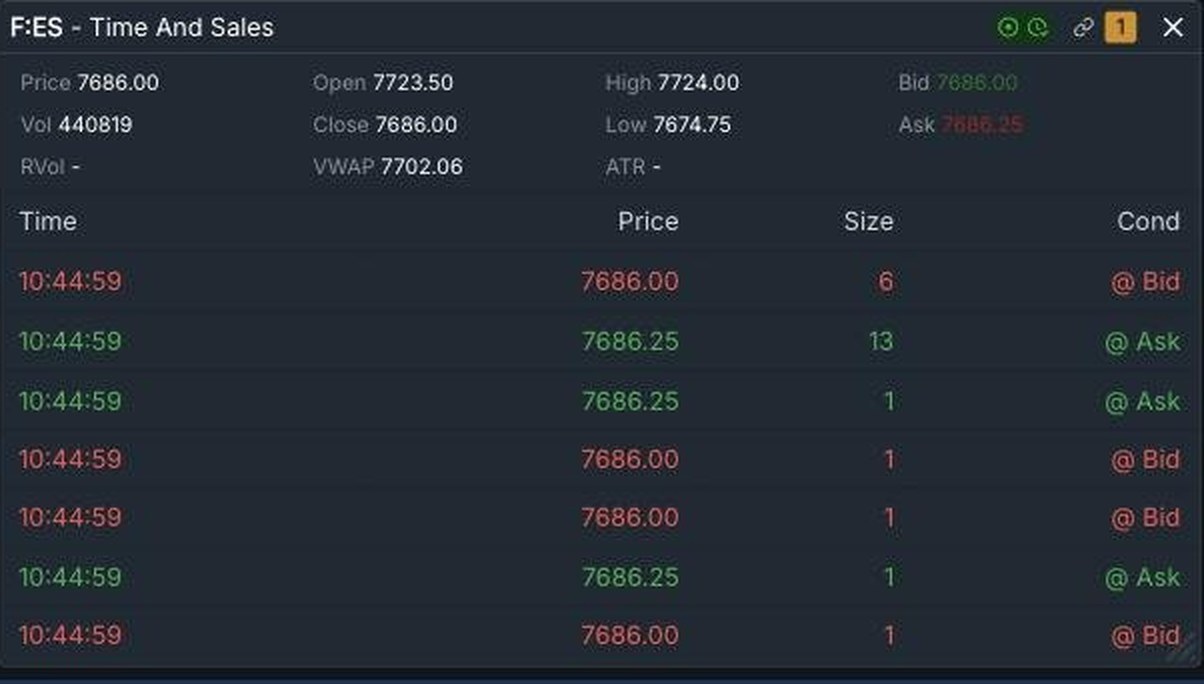
The tick grid in action: Time and Sales for the E-mini S&P 500 (F:ES) in a TradingSim replay of August 31, 2026, at 10:44:59 a.m. ET. Every print lands on either 7,686.00 or 7,686.25, the bid and ask sitting exactly one 0.25-point tick apart, with the session stats above showing the 7,723.50 open, 7,674.75 low, and 7,702.06 VWAP on 440,819 contracts.
Look at that tape for a moment. Every single print is 7,686.00 or 7,686.25. Not 7,686.10, not 7,686.17. The market is auctioning in quarter-point steps, and the bid-ask spread in a liquid index future is often exactly one tick wide, which is one of the quiet advantages futures hold for day traders. You can watch sellers hitting 7,686.00 and buyers lifting 7,686.25 and read the fight in real time. That is tick structure, and no amount of reading substitutes for watching it print.
Margin Is a Deposit, Not a Down Payment
The word margin means something different in futures than it does in your stock account, and confusing the two is the classic beginner error. In securities, margin is money you borrow, a partial down payment of up to 50 percent of the purchase price. In futures there is no loan and no interest, because you are not buying the asset at all. CME's margin lesson puts it plainly: futures margin is the amount of money you must deposit and keep on hand with your broker when you open a position. It is not a down payment and you do not own the underlying. Two numbers govern it. Initial margin is what CME Clearing requires to open the position, and maintenance margin is the minimum your account must hold while the position stays open. Your broker may be required to collect more than the clearinghouse minimum, and requirements rise when markets turn volatile. Fall below maintenance and you get the famous margin call, a demand to restore the account to the initial level, and a broker who can reduce or liquidate the position if you do not. Because that deposit typically runs only 3 to 12 percent of the contract's notional value, against up to 50 percent in securities, the leverage is real and so is the warning on the CFTC's basics page: speculators can be required to pay more than they initially invested. The leverage is a fact of the product, not a feature to maximize. I wrote about managing it contract by contract in margin trading E-mini futures.
The Session: Hours, Expiration, and Rollover
Equity index futures barely sleep. Per the CME FAQ, the E-mini and Micro E-mini index contracts trade Sunday through Friday from 6:00 p.m. to 5:00 p.m. ET, with a daily trading halt from 4:15 to 4:30 p.m. ET. That near-24-hour session is why futures react to overnight news while the stock market is dark, and why your chart has prints at 3 a.m. Contracts live on the quarterly March, June, September, December cycle and expire against a Special Opening Quotation of the index on the third Friday of the contract month, with the micros settling to the same value as their E-mini siblings. The practical consequence for a trader is rollover: as expiration approaches, volume migrates to the next quarterly contract, and you move with it or get left in a thinning market. I cover the mechanics and timing in my guide to futures contract rollover. One more structural point worth knowing early: micros and E-minis are offset eligible against each other at a 10 to 1 ratio through the clearing process, which underlines how deliberately parallel the two product sizes are.
Practice the Mechanics Before You Pay For Them
Everything above is learnable without risking a dollar, and in my view that is the only sensible order. Contracts, multipliers, ticks, and margin calls are mechanics, and mechanics are exactly what repetition teaches. In a trading simulator built on full-session replay you can load a real futures session like the one in the screenshots, scrub to any moment of the day, and trade it bar by bar, with the order ticket attaching a take profit and stop loss at entry and Time and Sales printing at a speed you can actually follow. TradingSim replays equities and futures sessions, so the homework for this article looks like this: pick one contract, replay ten full sessions, and before every entry write down the stop in ticks and the tick value in dollars. Ten sessions of that and the multiplier stops being trivia and becomes reflex. When you want to compare practice platforms for futures specifically, my guide to futures trading simulators walks through the options honestly, including ours.
What Is a Tick in Futures Trading?
A tick is the minimum price increment a futures contract is allowed to move, set by the exchange as part of the contract's standardized terms. On the E-mini and Micro E-mini S&P 500 the tick is 0.25 index points, worth $12.50 per contract on ES at its $50 multiplier and $1.25 on MES at $5. Prices can only print on that grid, which is why a liquid index future's bid and ask often sit exactly one tick apart. Ticks are the unit serious traders use to define risk: a stop is sixteen ticks, not "about four points," because sixteen ticks converts instantly into dollars per contract.
How Is Futures Margin Different From Stock Margin?
Stock margin is a loan: you borrow up to 50 percent of a purchase price and pay interest, and you own the shares. Futures margin involves no borrowing and no ownership. It is a deposit, held with your broker while the position is open, that demonstrates you can stand behind the trade. CME Clearing sets the initial margin to open a position and the maintenance margin your account must hold to keep it, typically 3 to 12 percent of the contract's notional value, and brokers may collect more. If losses pull the account below maintenance, the broker issues a margin call to restore it to the initial level and can liquidate the position if you fail to.
The Short Version
A futures contract is a standardized, exchange-traded, centrally cleared agreement that almost everyone closes before delivery. The multiplier prices a point, the tick prices the smallest step, and margin is a refundable deposit with teeth. Know those three numbers for your contract, in dollars, from memory. Respect the session clock and the quarterly rollover. And earn the mechanics in replay, one session and one journaled stop at a time, before the market starts charging tuition. Futures are not complicated. They are unforgiving, and the difference between those two words is preparation.
Tags:
About the Author
Al Hill
Co-Founder & CEO, TradingSim
Alton Hill is the Co-Founder of TradingSim with over 18 years of trading experience. He completed the Design Thinking Bootcamp at Stanford’s D.School and brings expertise in Product Development to create the best trading simulation experience. His strategy focuses on trend-following systems, targeting high-volatility stocks with strong primary trends using the 15-minute chart.
RUT Futures: How to Day Trade the Russell 2000 (RTY)
RUT Futures: How to Day Trade the Russell 2000 (RTY) Every few weeks a reader asks me where to find a quote for RUT futures, and the answer always starts with a small correction. RUT is the index...
Best Futures to Trade for Beginners: Your First Contract
Best Futures to Trade for Beginners: Your First Contract The question I get from almost every trader who decides to add futures to their toolkit is some version of which contract do I start with. It...
Micro vs Mini Futures for Evaluation Accounts The September equity index contracts expired on Friday morning, and the December contract is now the one on everyone's screen, micros and minis alike,...