✓ Reviewed by Kunal Vakil, Co-Founder of TradingSim · Updated Sep 9, 2026
Scalping Practice: Building Speed on Replay
Scalping punishes hesitation more than any other trading style. A swing trader who takes ten extra seconds to enter loses almost nothing. A scalper who takes ten extra seconds usually loses the trade. I have watched plenty of traders study scalping for months, memorize every setup, and still bleed money live because their hands could not keep up with their eyes. Reading about speed does not build speed. Repetitions do. That is what this article is about: a set of replay drills I use to train execution speed the same way athletes train footwork, in a trading simulator where a slow click costs you nothing but the lesson.
Scalping practice works best as structured drills on replayed market sessions rather than random simulated trading. Load a full historical session in a replay simulator, then isolate one skill at a time: first watch Time and Sales with no trades to learn the rhythm of the tape, then drill entries on a single repeating setup with a bracket order attached, then drill exits by forcing yourself flat within a fixed number of bars, and finally re-run the same session at a faster replay speed before returning to normal speed. Score every session on execution quality, not profit: how quickly you placed the order after your signal, how often you scratched a bad trade immediately, and how closely your fills matched your intended prices. Speed built this way transfers to live trading because the decisions, not just the clicks, get faster.
Why Scalping Is the Hardest Style to Practice
Most simulated trading fails scalpers for a simple reason: the practice environment is too slow and too forgiving. Watching a delayed chart drift along in real time gives you a handful of scalp setups per hour at best. You cannot build a physical skill on five repetitions a day.
Replay changes the math. When you can load any day trading simulator session from the recent past and jump straight to the open, the first pullback, or the afternoon breakout, you compress a week of live setups into a single evening. And because fills in a replay simulator only happen while the market is actually moving, you cannot cheat the clock. If you hesitate, the price is gone, exactly as it would be live.
The second problem is that scalping is really three separate skills wearing one name: reading the tape, entering without delay, and exiting without mercy. Traders who practice them all at once improve at none of them. The drills below split them apart on purpose. If you want the strategy side first, my guide to scalp trading strategies covers setups in depth. This article assumes you have a setup and trains the hands that execute it.
Set Up the Workspace Before You Drill
A scalping workspace needs three things visible at once: a fast chart, an order ticket, and Time and Sales. In TradingSim I run a one-minute chart as the primary, and the platform's timeframe menu goes down to seconds bars when I want to see the open in finer grain. The ticket sits beside the chart with quantity presets so share size is one click, and the stop loss and take profit checkboxes stay on so every entry goes out as a bracket. The risk-to-reward readout on the ticket updates as you drag the levels, which matters in drills where you grade your own precision afterward.
Time and Sales anchors the third panel. On equities you also get Level 2 depth alongside the prints. On the futures side, the E-mini S&P contract carries Time and Sales without a depth ladder in the current build, so if you drill on an index future you will lean on the tape alone. Either way, the session statistics in the panel header, open, high, low, last, and VWAP, give you honest reference levels for captions, journals, and stop placement.
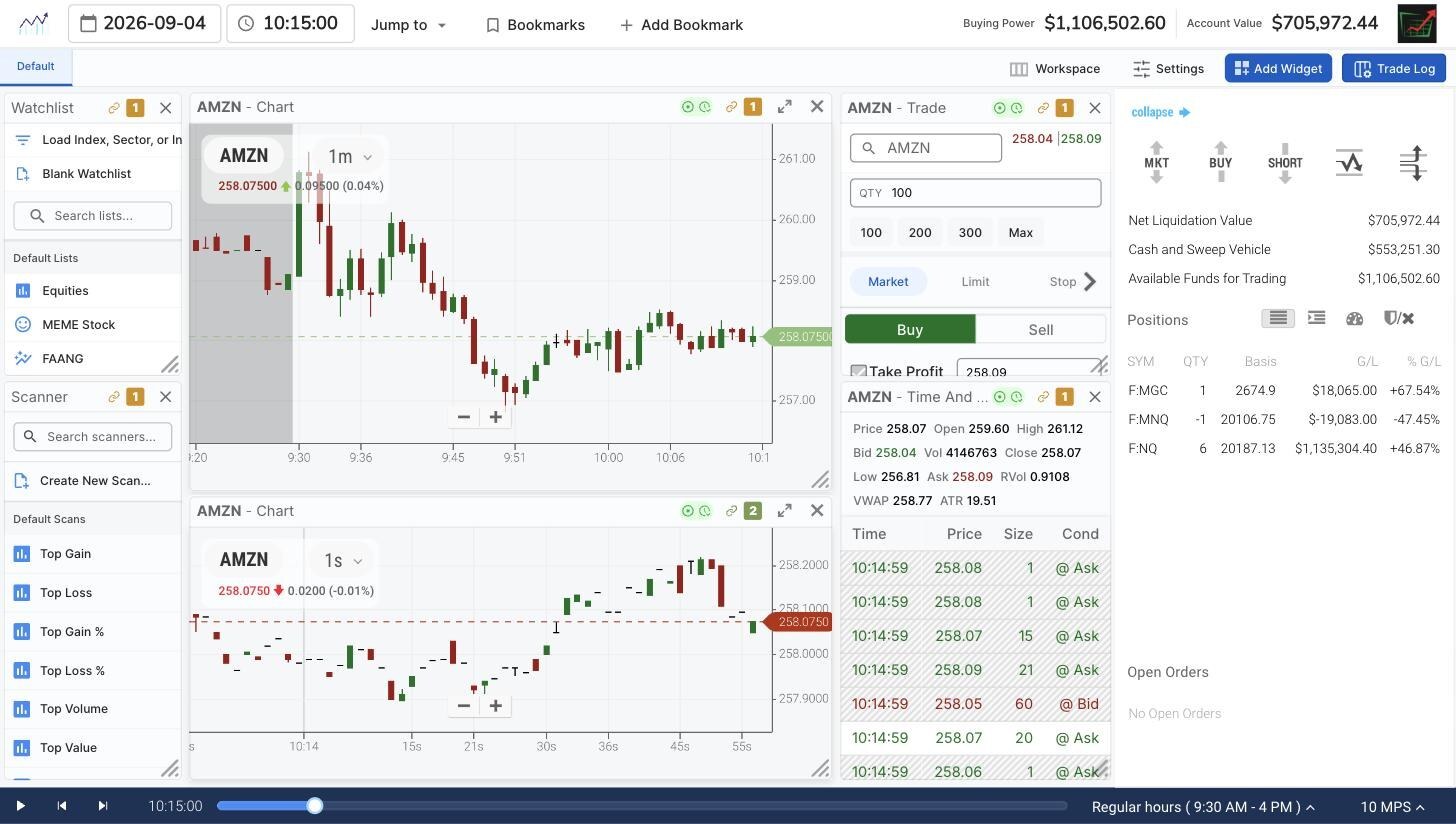
A scalping drill workspace in TradingSim Next Gen: AMZN session of September 4, 2026, replayed to 10:15 a.m. ET with the speed control at its default 10 MPS. The one-minute chart sits above a one-second chart of the same tape, the Market ticket is staged at 100 shares with Take Profit checked at 258.09, and the Time and Sales header carries the session stats: open 259.60, high 261.12, low 256.81, last 258.07 against a VWAP of 258.77 on 4,146,763 shares. The grey region left of the 9:30 open is pre-market, and the replay scrubber runs along the bottom.
Drill One: Read the Tape With Your Hands Off
The first drill has no trades in it. Load a session, jump the replay to five minutes before the open, and watch nothing but Time and Sales at normal speed for the first thirty minutes of the day. Your only job is to narrate what the prints are doing: where size is hitting the bid, where the offer keeps refreshing, when the pace suddenly doubles. Tape speed itself is a signal, and you cannot learn it from bars alone.
This feels like wasted time to most new scalpers. It is the opposite. Scalps live and die inside the spread, and the tape is the only place the spread tells its story. I wrote a full breakdown of the skill in my tape reading guide, but the short version is that you are training pattern recognition that has to become automatic before speed drills mean anything. Run this drill on the same session twice. The second pass, predict out loud what comes next. When your predictions start landing, move on.
Drill Two: Entry Speed on One Setup
Pick exactly one setup. A pullback to VWAP, a break of the opening range, a failed new low, whatever matches the strategy you already trade. Now replay a session and take every single instance of that setup, and nothing else, with a full bracket order: entry, stop, and target placed together from the ticket.
The scoring is what makes this a drill instead of practice trading. You are not grading wins and losses. You are grading the gap between the moment your signal completed and the moment your order was live. Watch the replay clock when the signal bar closes, place the trade, and note how far price moved before your fill. At first the slippage between decision and execution will embarrass you. That gap is the entire skill. Rerun the same session until placing the bracket feels like one motion instead of four decisions.
Because the simulator only fills you while the replay is running, pausing to think disqualifies the rep. Let it run. Miss the entry, mark it missed, and wait for the next one. Missed reps are data too. This drill borrows its structure from the wider set in my day trading practice drills article, but tightened to the single-setup, clock-on-the-wall version a scalper needs.
Drill Three: The Exit Drill
Scalpers do not blow up on entries. They blow up holding losers that were supposed to be thirty-second trades. The exit drill attacks that directly: every trade you enter must be flat within a fixed number of bars, no exceptions, winner or loser. On a one-minute chart I use three bars as the ceiling. If the trade has not paid within three bars, it was wrong, and the scratch is the win.
Run a full session this way and count your scratches. A high scratch count with small losses is a passing grade. A low scratch count with one big loser is a fail, even if the profit column looks better. You are training the reflex that overrides hope, and hope is the most expensive emotion in scalping. The habit generalizes beyond the drill, which is the point of the whole sim trading habits approach: what you repeat in replay is what shows up uninvited in your live trading.
Drill Four: Same Session, Faster Tape
Once a session feels manageable at normal speed, re-run it faster. The replay speed control in TradingSim steps up to ten times real time, which turns a calm mid-morning into something closer to a news open. Run the entry drill and the exit drill again at double speed or more, on the same session you already know. Familiarity is deliberate here. With the outcome no longer a surprise, all of your attention goes to execution under pressure.
Then, and this is the step people skip, drop back to normal speed for one final pass. After the fast tape, real time feels slow, and you will notice detail in the prints you missed the first time. Sprinters train with resistance and then run unloaded for the same reason. Keep the fast passes honest: if your accuracy falls apart at speed, slow down one notch rather than reinforcing sloppy clicks.
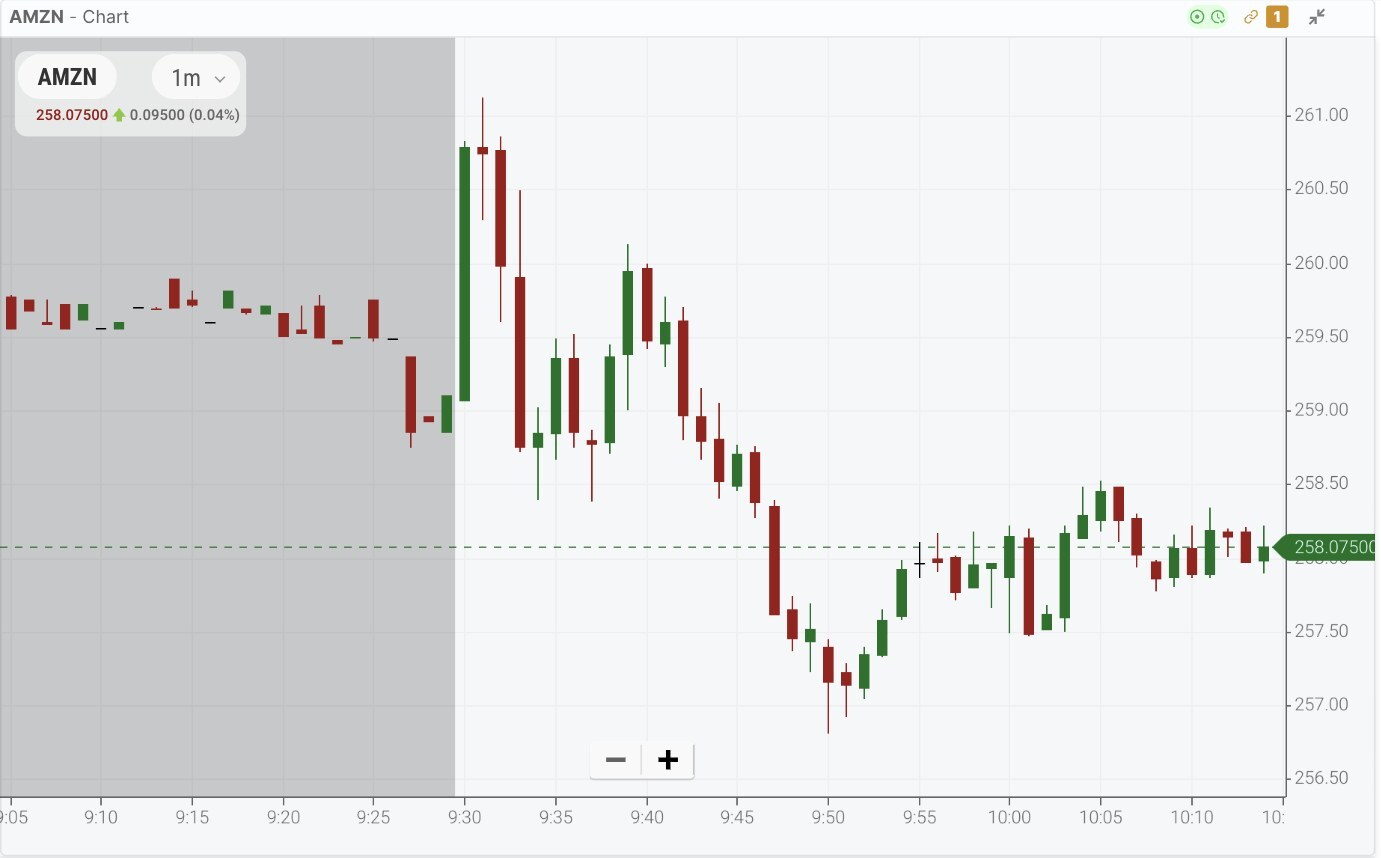
The same AMZN session of September 4, 2026 on a maximized one-minute chart, replayed to 10:15 a.m. ET. Off the 259.60 open the stock drove to its 261.12 session high inside the first minutes, unwound to the 256.81 low by roughly 9:50, then built the base and recovery back to 258.07 where the replay sits. This is the opening-range and pullback structure the entry and exit drills are built around, with pre-market shaded left of the 9:30 line.
Where Wyckoff Fits a Scalper's Preparation
I teach Wyckoff mostly on higher timeframes, but the framework earns its keep for scalpers as context. Before drilling a session, mark the prior day's range and ask which phase the stock is working through. A stock still ranging inside accumulation behaves differently at the edges of value than one already marking up: springs and tests at the low of a range produce the sharp reversal scalps, while a markup day rewards momentum entries on shallow pullbacks and punishes fading.
In replay this becomes a labeling exercise. Pause at the open, write down the phase you believe you are in and the scalps that phase favors, then let the session play and grade the call afterward. When I run this drill on a session I have already traded, the phase label usually explains most of my bad trades: they were good setups taken in the wrong context. Scalping does not exempt you from structure. It just gives you less time to remember it.
Score the Session or It Did Not Count
Every drill session ends with the same short review, and it goes in the journal before the workspace closes. Three numbers and one sentence: how many valid setups appeared, how many I executed inside my speed standard, how many I scratched on time, and one sentence about the worst trade. Profit does not appear in the review at all during drill blocks. The scoreboard is execution quality, because that is the variable the drills exist to move.
This review habit slots into the broader structure I laid out in my daily trading routine article. Drills are one block in that routine, not a replacement for it. If you are still setting up your simulated account and first week, start with the day trading practice account walkthrough and come back to speed work once the platform is muscle memory.
How Long Does Scalping Practice Take Before Going Live?
There is no honest universal number, so I will not invent one. The gate I recommend is competence based: you are ready to scale down to live size when, across multiple consecutive drill sessions on sessions you have never seen, your entry delay is consistently inside your standard, your scratch rule holds without exceptions, and your journal shows the same mistake is not repeating. For most traders that is weeks of consistent evening work, not days. The transfer question, what carries over from sim to live and what does not, is one I covered separately, and the answer for scalpers is blunt: mechanics transfer, emotions arrive on schedule the first day real money is on the line. Expect the speed you built to degrade under pressure at first. That is normal, and it is also why the standard in the sim needs headroom.
Do the Margin Rules Matter for Scalping Practice?
In the simulator, no rule stops you from taking fifty round trips a day, and that freedom is the point of drilling. Live is different, and 2026 changed the rulebook. FINRA replaced the old pattern day trader framework, including the well known 25,000 dollar minimum, with new intraday margin requirements effective June 4, 2026. There is no trade-count designation anymore. Instead your firm monitors equity against your open positions throughout the day, and an intraday margin deficit has to be satisfied promptly, with repeated failures risking a restriction of up to 90 days. Leveraged trading still requires 2,000 dollars minimum equity, and firms have until October 20, 2027 to transition, so your broker may still run the old rules today. Ask before you assume.
Cash accounts carry their own trap for high-frequency styles: with T+1 settlement, buying and selling the same security before paying for it with settled funds can trigger free-riding and good faith violations, which FINRA covers in its guide to frequent intraday trading. None of this exists in replay, which is precisely why the sim is the place to make your high-volume mistakes. Learn your order types cold while you are there. The SEC's plain-English types of orders page is the reference I hand to every new trader, and the bracket you drill in the simulator is just those orders assembled into one motion.
Speed Is a Byproduct
The strange thing about execution speed is that you do not get it by hurrying. You get it by shrinking the number of decisions left to make in the moment: one setup, one size, one bracket, one exit rule. The drills exist to move those decisions out of the trade and into the preparation. Run them on real replayed sessions, score yourself honestly, and the speed shows up on its own. Then the only thing left between you and the live tape is proving it on sessions you have never seen, and the simulator has an endless supply of those.
Tags:
About the Author
Al Hill
Co-Founder & CEO, TradingSim
Alton Hill is the Co-Founder of TradingSim with over 18 years of trading experience. He completed the Design Thinking Bootcamp at Stanford’s D.School and brings expertise in Product Development to create the best trading simulation experience. His strategy focuses on trend-following systems, targeting high-volatility stocks with strong primary trends using the 15-minute chart.
Tape Reading – How to Interpret the Time and Sales Window [Updated July 2026]
Reading the tape is one of the essential indicators when active trading. Many traders know about the hundreds of indicators readily available on most trading platforms, but very few have an idea of...
10 Day Trading Practice Drills to Run in a Simulator
Ask a struggling trader what their plan is and you will usually hear some version of "more screen time." I spent years believing that too. Watch enough charts and the market will eventually reveal...
Is Paper Trading Real Money? What Transfers to Live
Every few weeks someone asks me a version of the same question. They have been trading a simulator for a month, the account shows a gain, and they want to know what it means. Is paper trading real...








 Day Trading Indicators