✓ Reviewed by Kunal Vakil, Co-Founder of TradingSim · Updated Sep 19, 2026
Every Sunday afternoon my inbox has some version of the same question: the Nasdaq futures quote on some website moved over the weekend, so why couldn't I trade it? The short answer is that the quote you saw was not a real market. The long answer is worth understanding, because the gap between Friday's close and Sunday's open is one of the most consistent risk events on the weekly calendar, and most traders never practice for it.
Do Nasdaq futures trade on weekends? No. E-mini Nasdaq-100 futures (NQ) trade nearly 24 hours a day, five days a week on CME Globex: the week opens Sunday at 6:00 p.m. ET and closes Friday at 5:00 p.m. ET, with a one-hour maintenance halt each weekday from 5:00 to 6:00 p.m. ET. From Friday's close to Sunday's open the market is dark for roughly 49 hours. Weekend news cannot be traded until the Sunday reopen, which is why the first minutes of that session often gap. The only CME products that trade through the weekend are cryptocurrency futures and options, which moved to 24/7 trading on May 29, 2026. Equity index futures like NQ did not make that move. Any site quoting a live "weekend Nasdaq" price is showing a synthetic house quote, not exchange data.
The Real Nasdaq Futures Schedule, Hour by Hour
NQ runs on CME Globex, the exchange's electronic platform, and its week is best understood as five nearly continuous sessions rather than five separate days. The week begins Sunday at 6:00 p.m. ET (5:00 p.m. CT). From there the market trades straight through each night and day until 5:00 p.m. ET, pauses for a one-hour maintenance break, then reopens at 6:00 p.m. ET for the next trade date. That cycle repeats until Friday at 5:00 p.m. ET, when the market closes for the weekend. Full contract details are on the CME E-mini Nasdaq-100 specs page.
Inside that near-continuous week, not all hours are equal. The regular trading hours that mirror the U.S. stock market, 9:30 a.m. to 4:00 p.m. ET, carry the large majority of volume. The overnight hours are thinner, spreads widen, and a size that moves nothing at 10:00 a.m. can move the book at 3:00 a.m. I cover which windows carry real participation in my guide to high volume trading hours in futures markets, and the practical session-picking logic in optimal futures trading hours.
What Actually Happens to NQ Over the Weekend
Nothing. That is the plain answer, and it matters. From Friday 5:00 p.m. ET until Sunday 6:00 p.m. ET there is no NQ market: no bids, no offers, no prints. Earnings leaks, geopolitical headlines, central bank comments at weekend summits, all of it accumulates for two days with no mechanism to price it in.
Then Sunday at 6:00 p.m. ET the market reopens and prices all of it at once. That is the weekend gap. If the news flow was quiet, NQ reopens within a few points of Friday's close. If it was not, the first print can land far from Friday's settle, and there was nothing any trader could do about it in between. Anyone holding through the weekend wore that move at full size, which is why weekend exposure deserves more respect than a Tuesday overnight hold. I walk through the general decision in holding day trades overnight; a weekend is that decision with the risk window tripled.
Why You Still See "Weekend Nasdaq" Prices
Two things create the illusion of a weekend Nasdaq market. The first is crypto. CME moved its cryptocurrency futures and options to 24/7 trading on May 29, 2026, as announced in its February 2026 press release. Bitcoin futures now print real, regulated trades all weekend, and traders sometimes read weekend crypto direction as a proxy for Monday risk appetite. It is a sentiment clue at best. Crypto and the Nasdaq-100 correlate some weeks and decouple in others, and there is no arbitrage forcing them together while equity index futures are closed.
The second source is offshore CFD platforms that quote their own synthetic "weekend" versions of major indices. Those are house prices, made and managed by the platform itself, not connected to CME's order book. When Globex reopens Sunday evening, the real market is under no obligation to agree with anyone's weekend quote. Treat those numbers as a guess about the open, made by a counterparty who profits when its customers are wrong.
Trading the Sunday Open
The Sunday 6:00 p.m. ET open is a distinct trading environment and it deserves its own playbook. Liquidity in the first minutes is a fraction of what NQ carries during the day session. The book is thin, the spread can sit wider than usual, and stops resting from Friday get tested fast when the open gaps. Some of the cleanest observations I can offer after years of watching it: the first move off the Sunday open frequently overshoots the news that caused it, and the overnight session that follows often spends hours retracing part of the gap before U.S. traders arrive Monday morning.
None of that is a strategy by itself. It becomes one when you have watched enough Sunday opens to know what thin-book price action looks like. That is a replay problem, and it is exactly what a simulator is for.
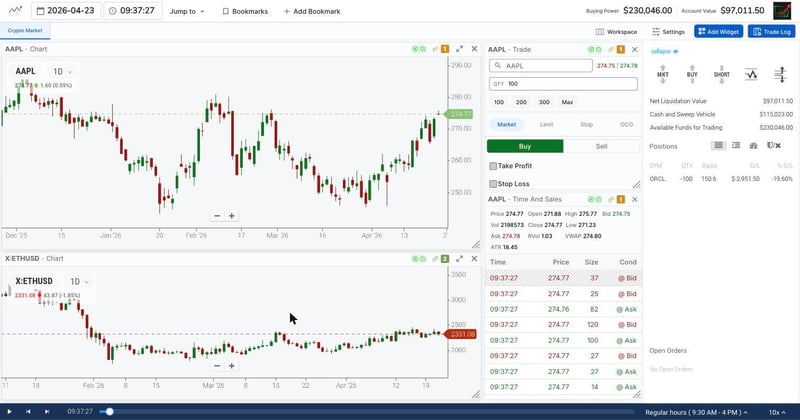
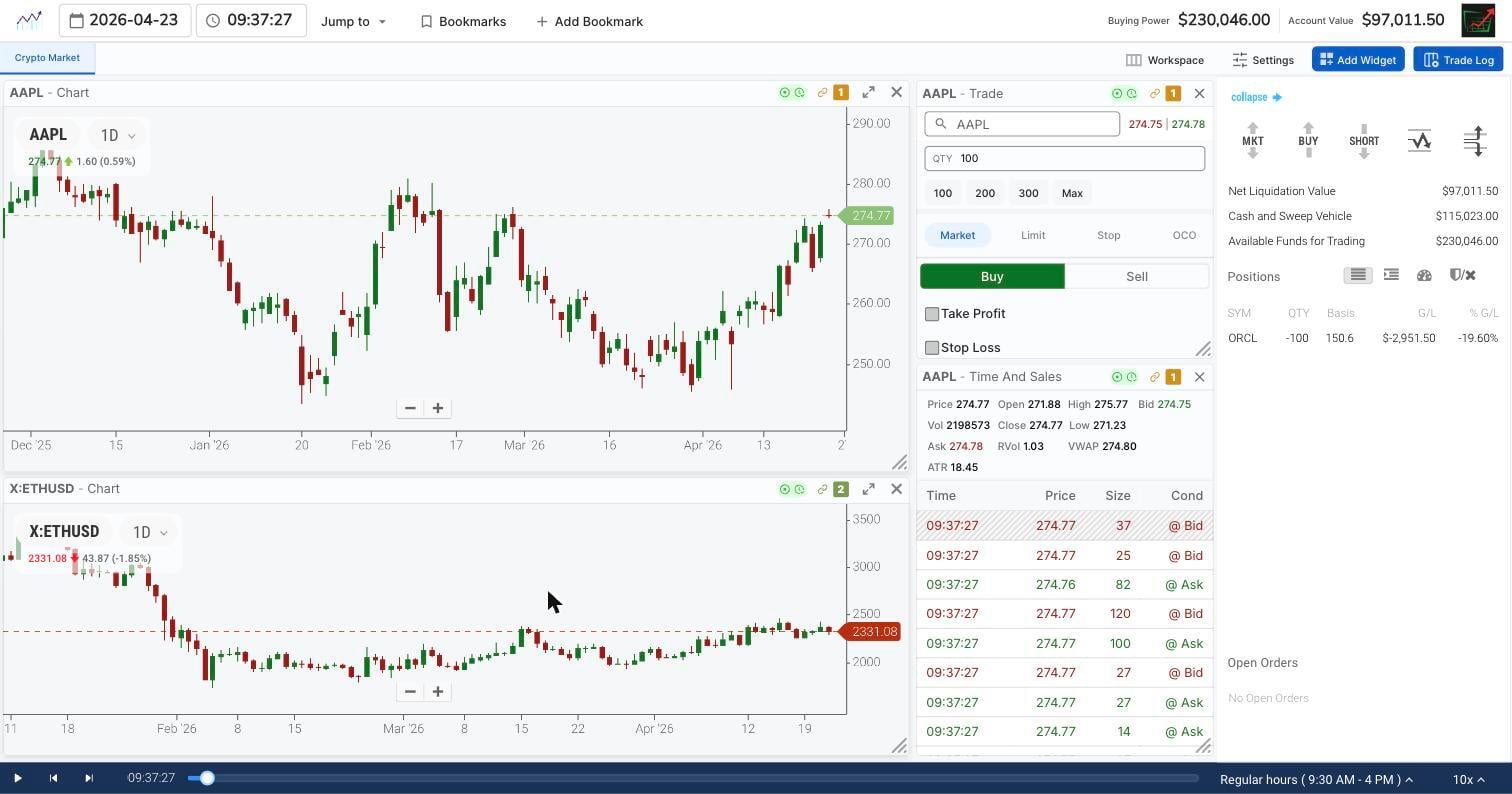
The TradingSim replay workspace. AAPL daily chart at 274.77 during a replayed session from April 23, 2026, clock at 09:37:27, with the order ticket and account panel live. Replay lets you re-trade a specific session, including the open, as many times as you need.
How I Practice Gap Opens in a Simulator
You cannot schedule your learning around live Sunday opens; there are only 52 a year and most are quiet. What you can do is drill the skill that Sunday opens demand, which is trading an open that prices in news you could not act on. In TradingSim, I do that by loading sessions where the market gapped at the open, then replaying the first 30 minutes over and over: where did the first push stall, when did the gap start to fill, what did volume do at the turn. The platform replays real historical market data for equities and futures, so the tape behaves the way it actually behaved, not the way a random-walk generator says it should.
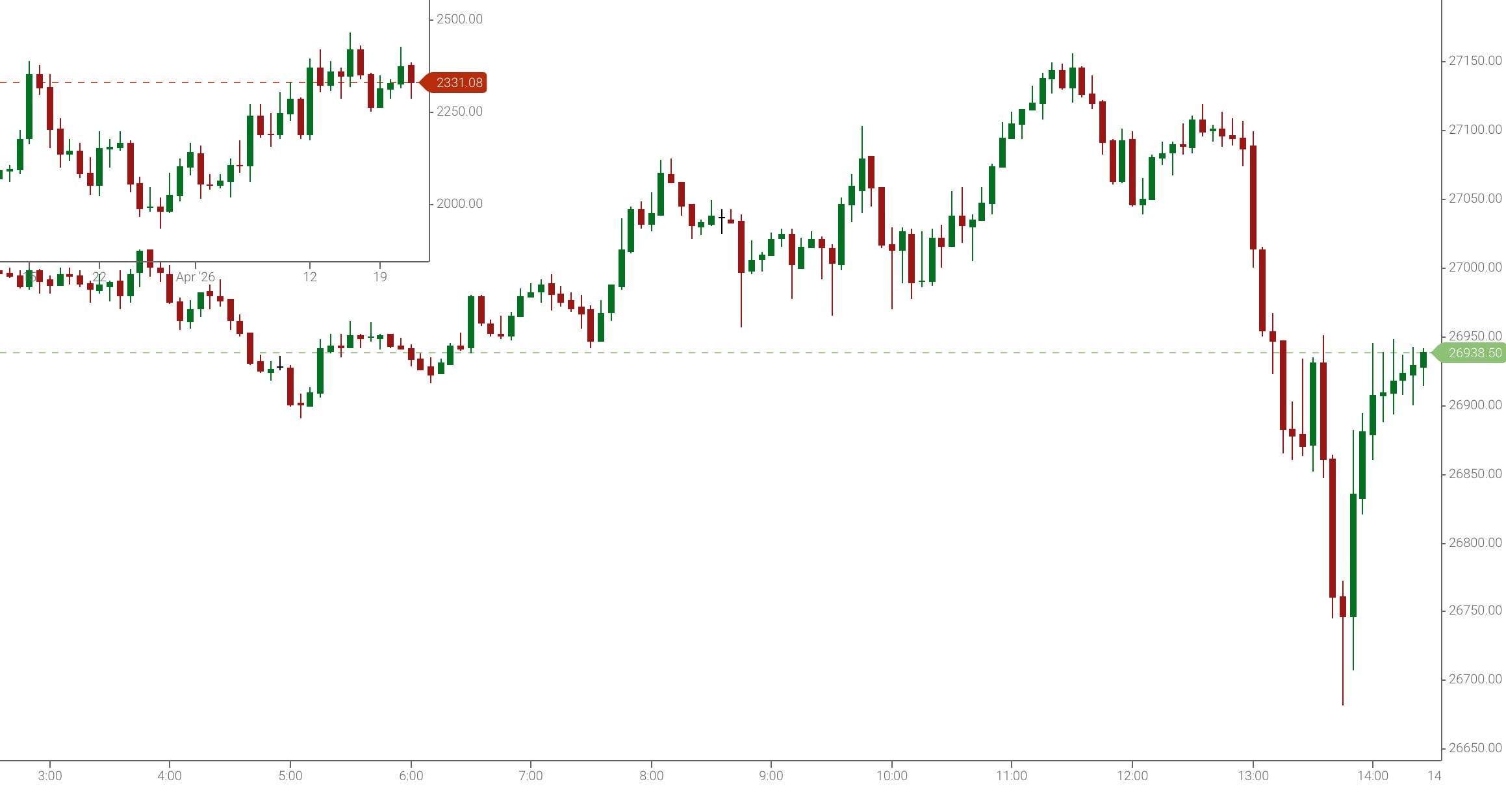
A full replayed session on the NQ 5-minute chart, April 23, 2026, with the overnight hours from 3:00 a.m. in frame: an afternoon break to roughly 26,700 and a recovery to 26,938.50 by 14:30. Overnight stretches and fast repricings like this are the drill material for Sunday-open behavior.
The same drill scales down. If full-size NQ risk per point is uncomfortable while you learn, the micro contracts cut every number by a factor of ten, and I explain that tradeoff in my beginner's guide to micro futures. For the broader toolkit, my guide to futures trading simulators covers what separates a real replay environment from a demo account with fake fills.
Managing Positions Into the Weekend
If you day trade NQ, the weekend is simple: be flat by Friday afternoon and the gap is someone else's problem. If you swing trade, the Friday decision is a real one. A few rules I hold myself to. Size the position for the gap, not for the average day; if a two percent Sunday gap against you would break your risk plan, the position is too big on Friday. Know your margin; carrying futures through the close means posting maintenance margin all weekend, and a gap can put you in a call before you can react Monday. And do not let a synthetic weekend quote talk you into panic; the only price that settles your P&L is the one Globex prints after 6:00 p.m. ET Sunday.
Context helps here too. NQ is a $20-per-point contract with a 0.25-point minimum tick, so a 100-point weekend gap is $2,000 per contract, before you have had your Sunday dinner. My rundown of five things to know about Nasdaq-100 futures covers the contract math in more depth, and if your strategy involves exiting late in the day, trading Nasdaq futures on the close pairs naturally with the Friday flat-or-hold decision.
The Weekly Rhythm Around the Close and the Open
Once you accept that the weekend is a hard stop, the hours on either side of it start to make more sense. Friday afternoon has its own character: traders who refuse weekend exposure flatten positions into the close, which can add a directional lean in the last hours of regular trading, and open interest tends to thin as shorter-term traders step aside. That flattening flow is one reason Friday closes sometimes drift against the day's trend for no visible news reason.
On the other side, the stretch from Sunday 6:00 p.m. ET to Monday's 9:30 a.m. ET cash open is one long overnight session, and it trades like one. Participation builds in waves as Asia opens, then Europe, then the U.S. pre-market. A Sunday gap that holds through all three waves is telling you the repricing was real. A gap that fades as each region arrives is telling you the first print overshot. I treat Monday's regular session open as the referee: until the full day-session crowd has voted, the Sunday move is a hypothesis, not a verdict.
That framing also keeps me from overtrading the quietest hours. Most weekends produce small gaps and slow Sunday sessions, and forcing trades into a dead book is its own leak. The skill is knowing which kind of Sunday you are looking at within the first half hour, and that pattern recognition comes from repetition, which is exactly what replay practice compresses.
Frequently Asked Questions
What time do Nasdaq futures open on Sunday?
NQ opens Sunday at 6:00 p.m. Eastern (5:00 p.m. Central) on CME Globex. That open starts the new trade week and is the first chance to react to anything that happened after Friday's 5:00 p.m. ET close.
Do any stock index futures trade on Saturday?
No. All CME equity index futures, including NQ, ES, YM and RTY, are closed from Friday 5:00 p.m. ET to Sunday 6:00 p.m. ET. As of mid-2026, the only CME products trading through the weekend are cryptocurrency futures and options.
Why did I see a Nasdaq futures price change over the weekend?
You were looking at either a stale quote, a crypto proxy, or a synthetic index quoted by an offshore CFD platform. None of those are the CME market. The real NQ price next prints at the Sunday reopen.
Is the Sunday open a good time to trade?
It is a thin, fast market that punishes market orders and rewards preparation. Most traders are better served watching the first minutes and trading the second or third reaction, and better served still practicing gap opens in replay before risking money on one.
Do weekend gaps usually fill?
Sometimes, and unevenly. Small gaps into quiet weeks fill more often than large news-driven gaps, but there is no reliable rule, and trading "gap fill" blindly is a fast way to fade a real repricing. Study each gap against the news that caused it.
Can I practice Nasdaq futures trading without risking money?
Yes. A futures simulator with historical replay lets you re-trade real gap sessions and overnight opens at your own pace. TradingSim replays real market data for equities and futures, so you can drill open-gap behavior repeatedly instead of waiting for one live Sunday a week.
Alton Hill is the Co-Founder of TradingSim with over 18 years of trading experience. He completed the Design Thinking Bootcamp at Stanford’s D.School and brings expertise in Product Development to create the best trading simulation experience. His strategy focuses on trend-following systems, targeting high-volatility stocks with strong primary trends using the 15-minute chart.
High Volume Trading Hours for Futures Markets [Updated August 2026]
Futures markets are mostly open 24 hours, six days a week from Sunday to Friday. This means that buyers and sellers can trade the market at any time of the day or night. But the freedom to trade the...
Nasdaq 100 Futures (NQ): 5 Things to Know [Updated May 2026]
The Nasdaq 100 futures are part of the index futures contracts offered by the CME Group. They are one of the popular index futures with different versions, but the e-mini Nasdaq 100 futures tops the...
Optimal Futures Market Trading Hours - A Comprehensive Guide [Updated May 2026]
Futures markets are an integral part of the entire financial markets landscape. Their influence on stocks and commodities is undeniably important — so much so that futures can portend price movements...







 Futures