✓ Reviewed by Kunal Vakil, Co-Founder of TradingSim · Updated Oct 31, 2026
Is Day Trading Hard? An Honest Assessment
Somebody asks me this at least once a week, usually right after they have watched a trader on YouTube turn four hundred dollars into four thousand before lunch. I have traded and taught trading for more than two decades, and I am going to give you the answer the highlight reels will not. Yes, day trading is hard. It is hard in a specific, measurable way that has nothing to do with intelligence and everything to do with who is on the other side of your orders, what the activity costs while you learn, and how your own nervous system behaves with money on the line. By the end of this article you will know exactly where the difficulty lives, what the best long-run research says about your odds, and the one approach that reliably shortens the apprenticeship.
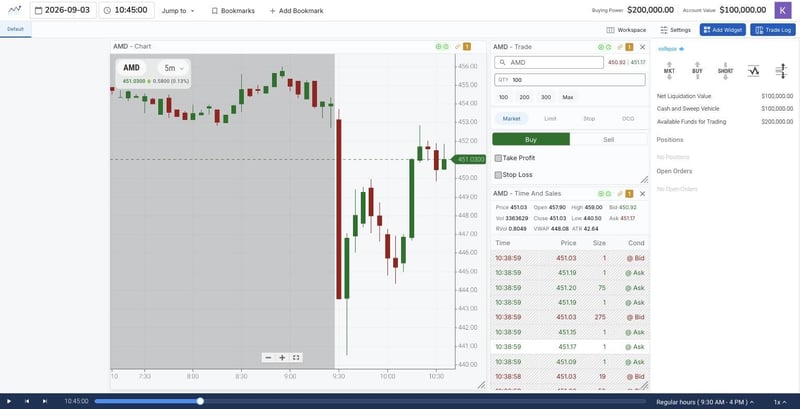
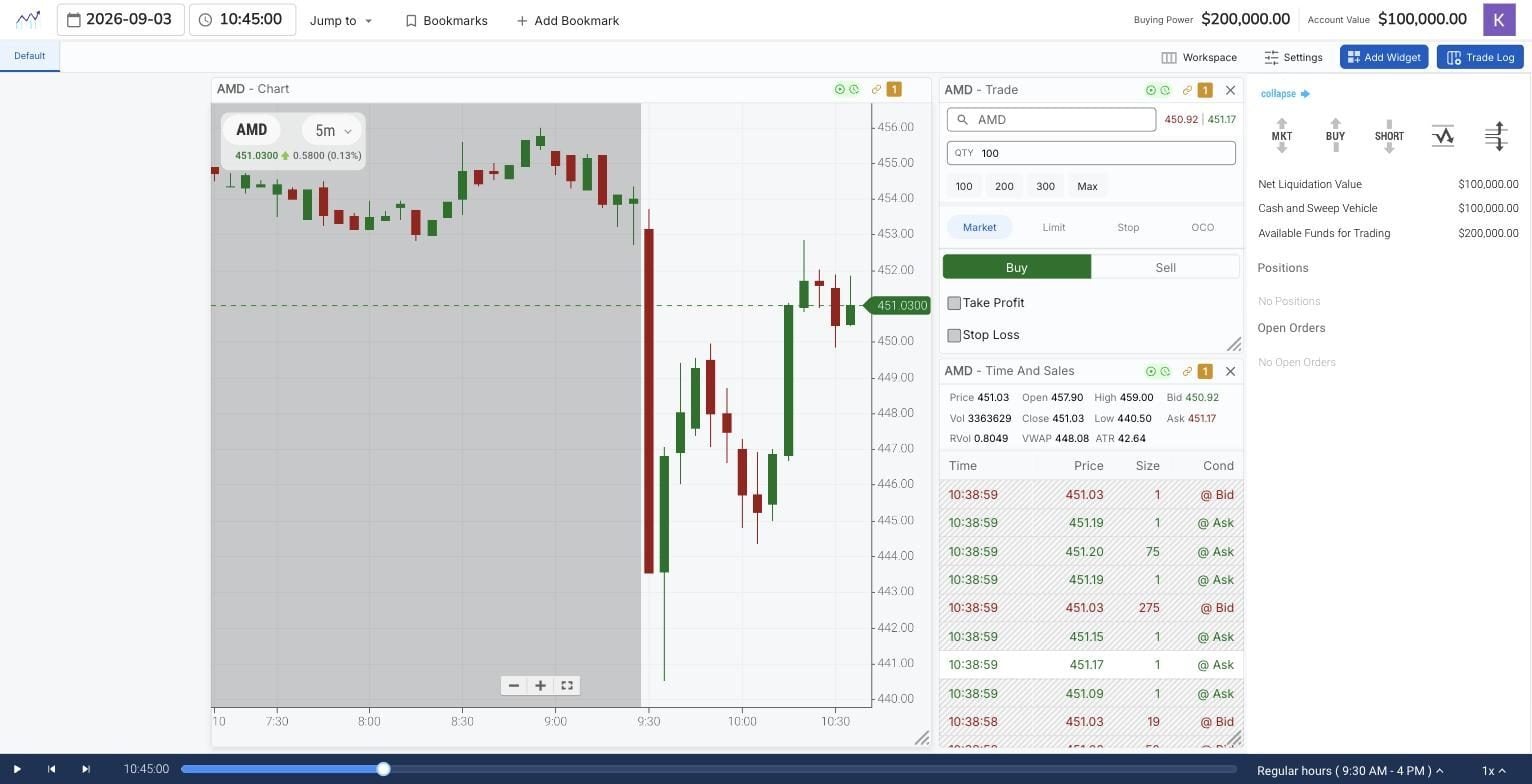
TradingSim's replay of AMD from September 3, 2026, paused at 10:45 a.m. ET. The 5-minute chart shows AMD at 451.03 after a 457.90 open, with a session high of 459.00, a low of 440.50, and VWAP at 448.08 on 3,363,629 shares. Time and Sales is printing around 451 at 10:38:59, the ticket is staged for 100 shares, and the account panel shows $200,000 in buying power against a $100,000 account. Processing all of this while the clock runs is the actual job.
Yes, day trading is hard, and the difficulty is structural rather than a matter of effort. You are competing in real time against professionals and algorithms, your costs are certain, and your edge is not. The most complete long-run data we have, a study of Taiwan's entire day trading population by Barber, Lee, Liu, and Odean, found that only about 5% of day traders are profitable in a typical year, that fewer than 1% earn profits predictably, and that more than 75% quit within two years. The SEC flatly calls day trading extremely risky. None of this makes success impossible. It makes day trading a performance skill with a long, expensive apprenticeship that most people try to skip. The traders who last treat it like a craft: they practice in a simulator first, size small, journal every trade, and grade themselves over months rather than days.
What the Research Actually Shows
Opinions about day trading are cheap, so let me start with the strongest dataset anyone has assembled. Because Taiwan's stock exchange recorded every trade by every account, researchers Brad Barber, Yi-Tsung Lee, Yu-Jane Liu, and Terrance Odean were able to study the complete population of day traders there across more than a decade, not a survey sample. Their findings, published in Do Day Traders Rationally Learn About Their Ability?, are blunt. The fraction of profitable day traders held consistently at about 5% year after year. Unprofitable traders generated 72% of all day trading volume. More than 75% of new day traders quit within two years, and in the team's related work on the same records, fewer than 1% of the population earned profits predictably enough to call it skill.
The American regulator reaches the same conclusion without the decimals. The SEC's investor education site describes day trading as "extremely risky" and warns that it "can result in substantial financial losses in a very short period of time." When the agency whose job is measured caution and the academics with the complete dataset agree, I take the agreement seriously, and I say that as someone who makes his living teaching this craft. I unpacked the failure-rate numbers and what separates the survivors in whether you can succeed as a day trader, so I will not repeat that whole analysis here. The short version is that the 5% who last are not smarter. They train differently.
Why Day Trading Is Hard: Speed, Noise, and an Adversarial Game
Most difficult skills are hard because the material is complex. Day trading is hard for a meaner reason: the game is adversarial. Every fill you get, someone took the other side, and on an intraday timescale the other side is disproportionately professional. Market makers, proprietary firms, and execution algorithms are faster than you, better capitalized than you, and completely unbothered by your stop loss. Long-term investing lets a rising economy do most of the work. Intraday, there is no tailwind. Your profit is someone else's loss on nearly every trade, which is also why people ask me whether day trading is like gambling. It does not have to be, but an untrained trader taking random entries against professionals is making a donation, not a wager.
The second layer is speed. Look back at that AMD workspace above. A day trader is reading the chart, the tape, the bid and ask, relative volume, and an account panel, and the correct decision window is often under a minute. Nobody gets to pause the market while they think. The third layer, the one that actually washes most people out, is that markets are noisy and your feedback is unreliable. Good decisions lose money and bad decisions get paid, sometimes for weeks at a stretch, which is exactly the environment where humans learn the wrong lessons fastest.
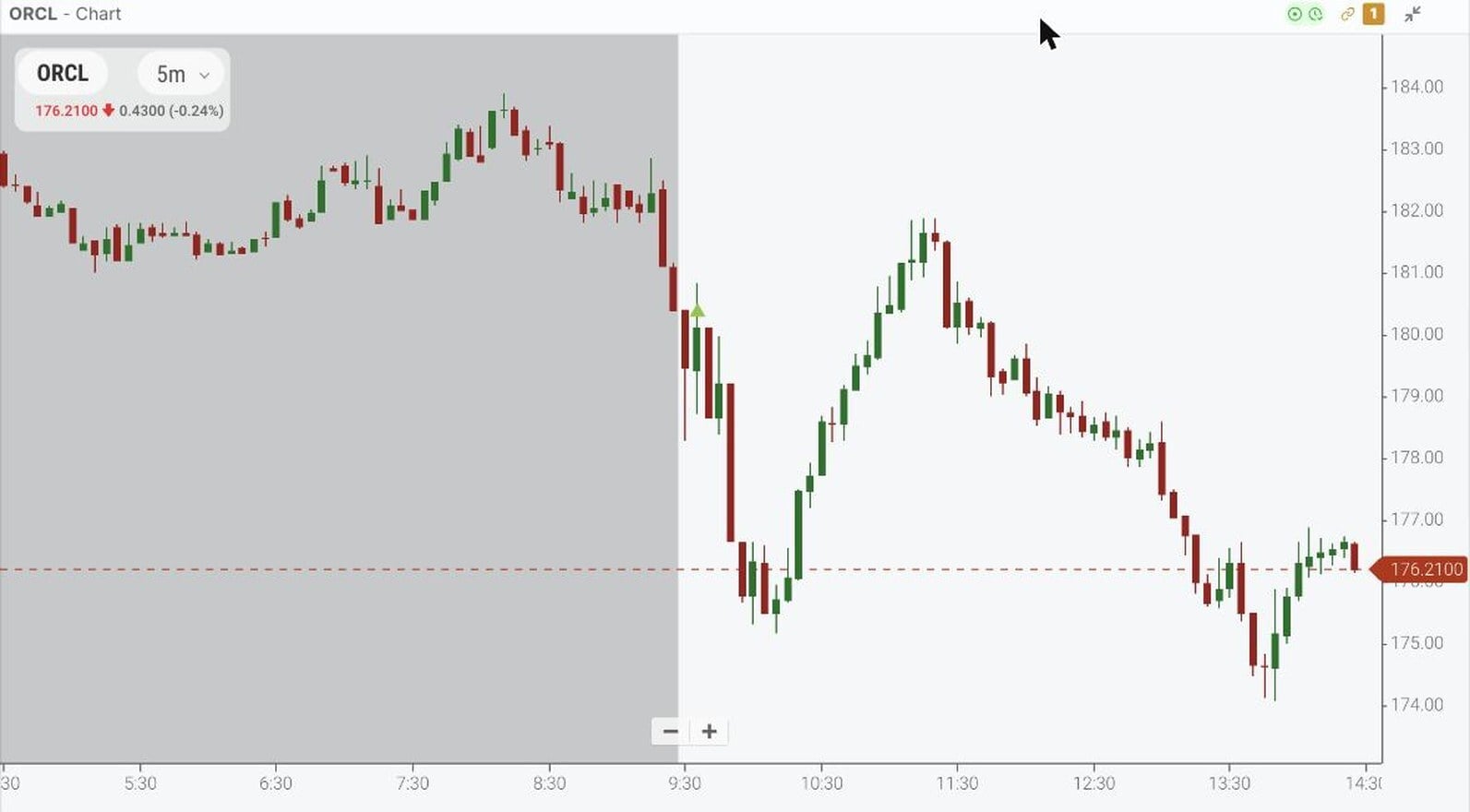
A TradingSim replay of Oracle (ORCL) from April 23, 2026, on the 5-minute chart. The long entry marker just above 180 right after the 9:30 open looked reasonable in the moment. Price flushed to the 175 area within the first half hour, recovered to nearly 182 by late morning, then faded to a 174.00 low after 1:30 p.m., with the session printing 176.21, down 0.24%, at the right edge. Both the entry and the punishment are recorded market data, and this is the kind of two-sided trap that makes intraday trading hard.
That Oracle session is worth a long look because it shows the difficulty honestly. The entry above 180 was not stupid. The stock had pulled back from its premarket high and appeared to be stabilizing. It then dropped five points in thirty minutes, rallied all the way back and more, and rolled over again into the afternoon. Three separate groups of traders got hurt in one ordinary session: breakout buyers at the open, bottom fishers who got shaken out before the recovery, and momentum chasers who bought the late-morning strength. Nothing about that day was unusual. That is Tuesday. Managing your own reaction to it is the skill, which is why I tell every student that trading psychology is not a soft topic. It is the curriculum.
The Costs That Make It Harder Than It Looks
Difficulty compounds through your cost line. Commissions on equities are mostly zero now, but the spread, slippage on fast entries, and the occasional bad fill are not, and a trader making a thousand round trips a year pays those tolls a thousand times. Short-term gains are also taxed at ordinary income rates in the United States, so the net hurdle is higher than the gross one. None of these costs care whether you are any good yet.
The rules changed recently too, and if your information is from an older article, it is stale. FINRA adopted new intraday margin standards in Regulatory Notice 26-10, which replaced the old day trading margin framework in its entirety, including the pattern day trader designation and its $25,000 minimum equity requirement, effective June 4, 2026. Firms are allowed to phase the new standards in until October 20, 2027, so during the transition your broker may still be running the old thresholds. Under the new framework the baseline margin account minimum is $2,000, intraday margin requirements apply to your positions during the session rather than only at the close, and a habit of creating intraday deficits and not covering them promptly can get your margin access frozen for 90 days. Lower entry minimums do not make the game easier; they make it easier to enter, which is not the same thing. Leverage cuts both ways, as I showed in how to day trade with margin, and the full account-type picture, cash accounts included, is in my guide to whether day trading is legal. Hard and illegal are different things. Day trading is permitted; it is simply unforgiving.
How to Make Day Trading Less Hard
Here is the part I can offer beyond a warning. The difficulty of day trading is concentrated in the first thousand or so trades, the ones where you are paying full market price for your education. You cannot skip those repetitions, but you do not have to fund them with real losses. Surgeons rehearse on simulators, pilots log hours in them, and the logic transfers directly: a day trading simulator lets you take those first thousand trades against real recorded market data with the clock running and nothing but your ego at stake. Both screenshots in this article come from replay sessions, the AMD workspace and the ORCL trap alike, because replay is how I teach. You can trade the same brutal session ten times until you stop giving the trap your money, something the live market will never let you do.
Practice only works if it is deliberate, so structure it. Trade one setup until your execution of it is boring. Size small enough that no single trade matters, in the simulator and doubly so when you go live. Journal every trade, entry, exit, and the reason, and grade yourself on process over no fewer than twenty trades at a time, because on this timescale any single outcome is mostly noise. Treat simulated profits with suspicion and simulated discipline as the real signal; I wrote about that honestly in whether paper trading is real money, because the sim will not replicate the fear of loss, and you need to know what it does and does not prove. When you do go live, the market will still be hard. You will just be meeting it with a tested playbook instead of a theory.
Is Day Trading Harder Than Long-Term Investing?
Yes, and it is not close. A long-term investor in a broad index needs patience and almost no daily skill, and historically the market's upward drift has done the heavy lifting. A day trader gets no drift. Intraday trading is closer to a zero-sum contest where your counterparties are professionals, your decision windows are measured in seconds and minutes, and your costs recur on every trade. The research gap matches the structural one: diversified long-term investors as a group have tended to earn the market's return, while the complete Taiwan records show only about 5% of day traders profiting in a typical year. The honest comparison is between an activity that rewards you for doing almost nothing and a performance skill that punishes almost everyone who attempts it casually. If you want the skill anyway, respect the gap and train for it. Wanting the lifestyle is not the same as wanting the work.
Does Practicing in a Simulator Actually Make Day Trading Easier?
A simulator does not make the market easier. It makes you cheaper to educate. The difficulty we have covered, adversarial counterparties, fast decision windows, noisy feedback, does not disappear in practice; what changes is the cost of each mistake while you climb the learning curve. Replay practice compresses the apprenticeship in a way live trading cannot, because you can rehearse the same opening drive, the same failed breakout, the same news candle repeatedly until your response is automatic, and the data is real recorded market activity rather than a random number generator. The limits are real too. A simulator cannot reproduce the fear of losing rent money, so your simulated discipline will always overstate your live discipline. Use it to prove your process works and to fail cheaply while you are bad, which everyone is at first. Then go live small and let real stakes finish the training.
Tags:
About the Author
Al Hill
Co-Founder & CEO, TradingSim
Alton Hill is the Co-Founder of TradingSim with over 18 years of trading experience. He completed the Design Thinking Bootcamp at Stanford’s D.School and brings expertise in Product Development to create the best trading simulation experience. His strategy focuses on trend-following systems, targeting high-volatility stocks with strong primary trends using the 15-minute chart.