✓ Reviewed by Kunal Vakil, Co-Founder of TradingSim · Updated Mar 31, 2026
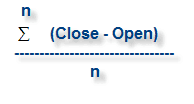
The Qstick indicator was developed by Tushar Chande, in order to determine the strength or weakness of a security over ‘x” period of time. The Qstick indicator represents the moving average of the difference between the opening and closing prices of a security. A positive value means the security has had more net points up over “x” period, while a negative value means the security has had more net points down over “x” period. So, if a stock is up 10 points in one day, but down a total of 7 points the other 9 days, the stock will have a positive qstick value. The formula for the rate of Qstick is as follows:
Qstick Formula
Trading Rules – Qstick
The Qstick like many other technical indicators provides a number of trading signals based on the values of the readings and divergences. Below are three basic rules for trading with the Qstick.
Crossovers
The Qstick oscillates above and below the 0 line. A very basic trading principle is to buy a security on a cross up over the 0 line and to sell the security on a cross down through the 0 line. This technique will work well in sideways markets as the security is more likely to adhere to support and resistance levels.
Extreme Levels
The Qstick also provides extreme readings that can often call market tops and bottoms. The Qstick value has no upper or lower limits, so traders will have to look at previous tops and bottoms in the indicator when going counter to impulsive moves.
Divergence
The last trading rule for the Qstick indicator is to look for divergences between the price of the security and the indicator. So, traders will want to purchase the security if the Qstick value is increasing and the price is moving down. Conversely, traders will want to sell when the Qstick value is falling and the price is rising.
Tags:
About the Author
Al Hill
Co-Founder & CEO, TradingSim
Alton Hill is the Co-Founder of TradingSim with over 18 years of trading experience. He completed the Design Thinking Bootcamp at Stanford’s D.School and brings expertise in Product Development to create the best trading simulation experience. His strategy focuses on trend-following systems, targeting high-volatility stocks with strong primary trends using the 15-minute chart.
Relative Volatility Index (RVI) – 2 Simple Trading Strategies
Have you ever heard of the RVI technical indicator? I am not talking about the relative vigor index, termed RVI or RVGI. I am referencing the relative volatility index! In this article, I am going to...
Trending Stocks – 7 Things You Need to Know Before Investing
#1 – What is the Definition of a Trending Stock? A trending stock is one that is increasing or decreasing in value on a defined slope. Can you see how hard the stock is trending up and to the right?...
2 Simple Strategies for Trading with the Tick Index
Many of the technical indicators discussed on the TradingSim blog deal with assessing a particular stock or ETF. However, in this article we will cover the tick index, which is a broad market...









 Trend Indicators