✓ Reviewed by Kunal Vakil, Co-Founder of TradingSim · Updated Jul 15, 2026
Buy Stop Order: How It Works & When to Use It [Updated July 2026]
Feeling overwhelmed with the various order types you can place in the market?
Well, let me be the first to tell you that it can feel like swimming in a sea of endless possibilities. While you may not use every order type, it is important to at least be aware of the options that for you to apply to your trading regiment.
In this article we are going to cover the buy stop order and when you will want to use this order type.
The buy stop order is an instruction to your brokerage firm to execute a long position at the market at a predetermined price. This order type is available across all security types (stocks, futures, options, and forex).
How to Enter a Buy Stop Market Order
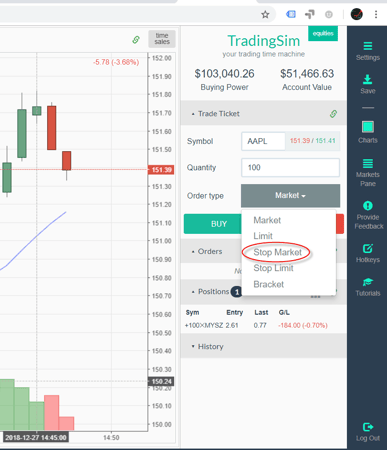
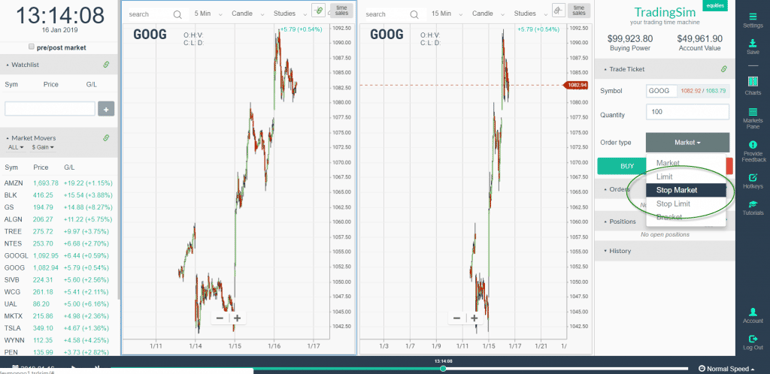
Select Stop Market Order
Navigate to the order entry portion of your trading platform and select stop order. In TradingSim, this is located within the trade ticket area of the platform.
Stop Market Order
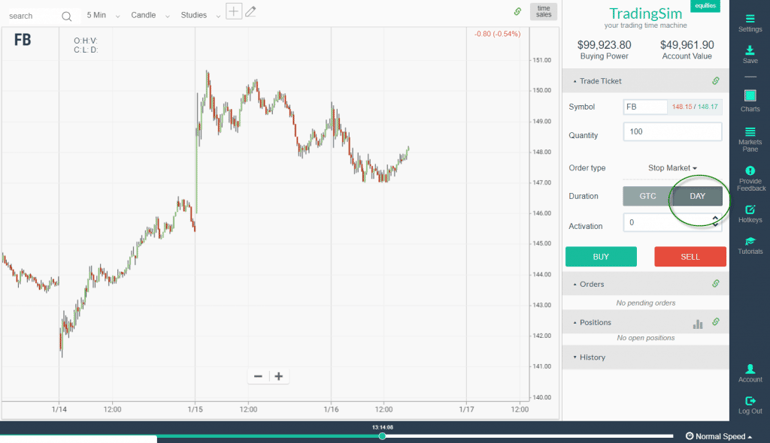
Select Order Duration
Next, you need to select if you want the order to expire on the same day or if you want a good-til-cancel order which often lasts for 30 days.
In this buy stop market order example, we have selected day order. If you are day trading, I recommend you also use day orders. The last thing you want is to have a GTC order out there that executes.
Take it from my experience; there is no greater fear when trading of not knowing you held a position overnight that the system opened on its own when you were not even at your desk.
Stop Market Order
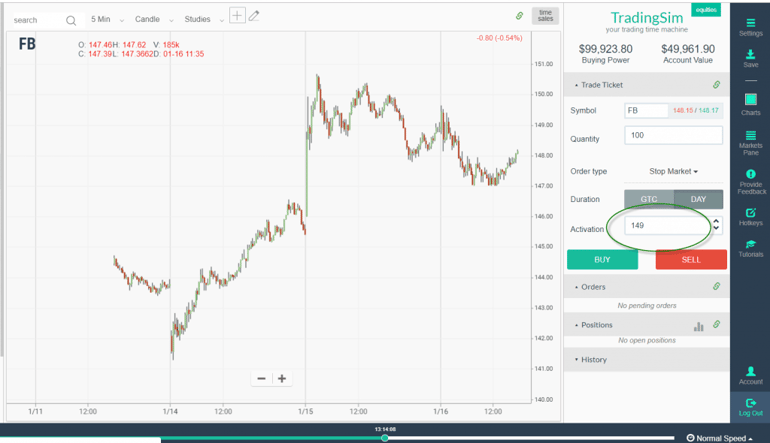
Enter Desired Price
Buy Stop Market Activation Price
In this buy stop market order example, I have entered 149 as the buy level. This means if Facebook were to hit 149, my market order would trigger.
Determining Which Buy Stop Market Order to Use
As a trader, you first need to determine if you are going short or long.
Long Traders
If you are going long, you will want to enter a buy stop order to enter a position. This means you are willing to buy a stock once it climbs higher to a specific price.
You will find that traders going long with stop market orders are breakout traders.
Short Traders
For short traders, a buy stop market order is what you use to exit a position. This means that you are short a position and the buy stop market order is where you will close out the position to prevent any further losses.
Where can Buy Stop Market Orders Fail You?
The big issue with buy stop market orders is you don’t know what price you are going to get on your order. For example, if you are looking to enter a position at $100, your order will execute the trade at any level above $100.
Now, where the price spreads are tight, this is not an issue. However, if the spreads open up, you could end up paying way more than you would like.
Why is this important?
When day trading, each quarter percent can be critical towards your bottom line. Therefore, market orders can lead to uncertainty in terms of your ability to estimate your profits.
For example, in my own experience, when I enter a buy market order for short trades, it’s likely not a good experience.
When a market is racing higher, shorts are tripping over one another to get out of the position. So, what do you think that will do for you when trying to exit the position?
That’s right, you are going to be racing to get out and will essentially take whatever price you can get.
Pros and Cons of Buy Stop Market Orders and Limit Orders
If you are a trader that you are looking to get into a trade and will manage the risks, a stop market order is likely your best bet. This can be the case if you are looking to purchase a large order or if you are trading penny stocks that move quickly and certain price levels are jumped.
If you are scalp trading and each tick has tremendous value to you, then you will want to use limit orders.
Trading High Volume Stocks
If you are trading high volume stocks, limit orders should be your preference. For example, if you are trading Facebook or Apple, do you think you will ever have trouble filling a limit order?
Probably not. So, if you can place a limit order you will not have a problem getting filled.
How Can TradingSim Help?
Regardless of your system, you need to see which order type works best for you. You will want to test market, stop and limit orders to see which methods will generate the most profit for your business.
Frequently Asked Questions About Buy Stop Market Order [Updated July 2026]
What is a buy stop market order?
A buy stop market order is an instruction to buy a security once its price rises to or above a specified stop price. When the stop is touched, the order converts into a market order and fills at the next available price, which may differ from the stop in fast markets.
When should you use a buy stop order?
Traders use buy stops to enter on breakouts above resistance, to add to winners as momentum confirms, or to cover a short position if price moves against them. The order only activates once the market proves strength by trading up to the stop.
What is the difference between a buy stop and a buy limit order?
A buy stop sits above the current price and triggers on a move up, typically for breakout entries. A buy limit sits below the current price and fills only at or better than the limit, typically for buying a pullback. They serve opposite intentions.
Can a buy stop market order suffer slippage?
Yes. Because it becomes a market order once triggered, a buy stop can fill above your stop price during gaps or fast-moving markets. Traders who want to cap the fill price use a buy stop-limit order instead, accepting the risk of no fill.
Does a buy stop guarantee execution?
A buy stop market order is very likely to execute once triggered because it becomes a market order, but it does not guarantee a specific price. A buy stop-limit, by contrast, guarantees price but not execution.
This guide was reviewed and updated in July 2026 by the TradingSim editorial team. Practice these concepts risk-free in the TradingSim day trading simulator.
Alton Hill is the Co-Founder of TradingSim with over 18 years of trading experience. He completed the Design Thinking Bootcamp at Stanford’s D.School and brings expertise in Product Development to create the best trading simulation experience. His strategy focuses on trend-following systems, targeting high-volatility stocks with strong primary trends using the 15-minute chart.
Stop Limit Orders – How to Execute and Why Traders Use Them [Updated August 2026]
I exclusively use stop limit orders to enter day trades. This is because I trade breakout strategies and I like to wait for the price to exceed the most recent high or low. In this article, I will...
Trailing Stop Loss – Learn How to Manage Your Trades [Updated September 2026]
Key Takeaways (Updated June 2026) A trailing stop loss is a stop order that moves with price in your favor, locking in gains while capping downside. For most active stocks, a 5%-15% trail balances...
In this article we will cover three basic trading strategies you can use with above the market order types. You maybe thinking that order types is too negative, but you will be surprised to know that...








 Types of Trades