5 Signs You Should Avoid Trading During Slow Markets
Dec 6, 2021
Written by: John McDowell
✓ Reviewed by Al Hill, Co-Founder of TradingSim · Updated Mar 31, 2026
We all love to trade. That’s a fact. There’s just something about waking up each day to new opportunities and fresh trades waiting for us. But what happens when the market shifts, and suddenly the momentum has died. That’s a red flag, and it is one of the reasons why most traders should avoid trading during slow markets.
In this post, we’ll discuss a handful of reasons you should avoid trading.
Avoid Trading when the Market Slows
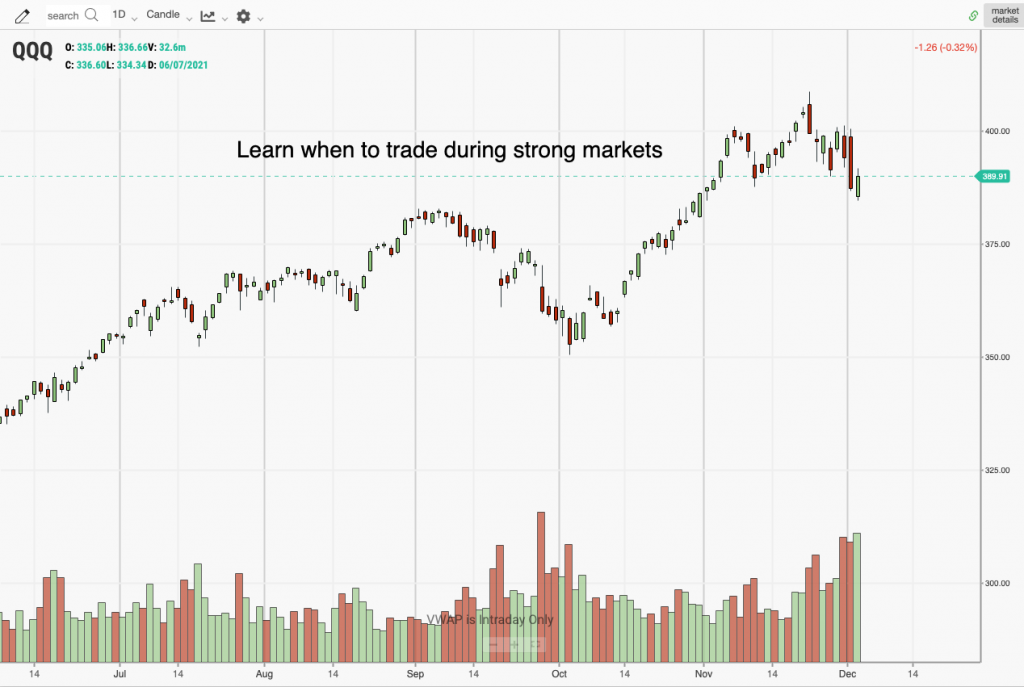
It goes without saying that the majority of stocks follow the general market. There will always be exceptions to the rule, but if the market is in a correction, you can expect 90% or more stocks to be in a correction as well.
This is why it is so important, even for day traders, to be in tune with the general market. Ask yourself questions like:
Are big operators putting money in or is the action just slow?
How many opportunities are showing up each day?
Depending on your answer to some of these questions may determine whether or not you need to take a break with the market. It doesn’t always pay to play. Sometimes, it’s best to take the time the market is giving you to do just that: play!
QQQ in correction
These can be great times to spend with family, go on vacation, or find some other quality stimulus to fill your time with.
The bottom line is that most of us should be trading less. Much less. Activity born of true passion *gives* us energy. If you’re finding yourself drained by the work of trading, you are probably shortchanging the rest of your life and jeopardizing your returns with the overtrading that results from lack of focus.
Dr. Brett Steenbarger ph.d.
This is why it is so imperative to step away from the desk at times.
Avoid Trading when the Setup Isn’t There!
Despite what the general market is doing, you may find that your prized strategy hasn’t been working lately.
Now, that doesn’t mean you can’t find some sort of edge in the market, or that you might need to adapt a little. However, we find that when your setup isn’t “showing up,” it’s time to take a step back.
For newer traders, if you even have a setup, you’ll be inclined to “put on a trade” just to “see what happens.”
This isn’t trading. This is gambling, and it is reckless with your money. “Let’s see what happens” isn’t a strategy. It is a sign of boredom.
If the volume doesn’t meet your criteria, the momentum, the price action, etc., then sit on your hands. Get up, walk away. There is no reason to force trades when the setup you know and love isn’t presenting itself.
Take a Break after a Series of Losses
As a general rule of thumb, we like to give ourselves three strikes before we bench ourselves. If you can’t place one winning trade out of three, something is bad wrong.
Whatever the case may be, three strikes is a good reason to go sit on the bench and review the pitches you swung at. Why didn’t the trades work? What did you not see? Was something in the broader sector weak?
Sometimes, the review process is more important than trying to force more trades and revenge your way out of a slump.
When this happens, take a step back and realize that it might not be you. We’re all human, and it takes reflection to gain insight into our trades and why they went wrong. Get back to the sim, analyze your trades, and wait for the dust to settle before you put money to work again.
Avoid Trading when You Aren’t Rested
We’ve spoken about this in our blog titled 7 Physical Habits That Impact Trading Performance. Most people don’t understand that trading is a performance activity, akin to any kind of sport or artistitic work.
To that end, you must be ready to perform. If you didn’t sleep well, exercise, eat well, etc., you may not be on top of your game. There are so many things that go into trading well that we don’t realize.
One of those things is feeding the frontal cortex. When we don’t sleep well, our amygdala steals the blood flow from our frontal cortex, which is recipe for disaster. Responsible for the fight or flight syndrome, the amygdala is not what we want to be using when we need to be calm and logical.
So, consider that if you aren’t rested or physically prepared for trading, it may be best to set some rules for your trades, or avoid trading altogether.
Avoid Trading when You’re Emotional
Aside from physical habits, emotional habits can also wreak havoc on your trading. For this reason, it’s best to avoid trading when you’re angry, tired, bored, or even excited.
Trading well requires an even keel. Too much anger and you’ll try to force trades or revenge trade. Too much apathy and you’ll put on trades for no reason. Too much excitement and you’re liable to overtrade just for the thrill of it.
Take inventory throughout your trading day of your emotions. Make notes of how you feel during trades and rate yourself on a 1-10 scale so that you can keep track of your emotional state. Awareness is always the first step.
Once you get a grip on your emotional issues, learn to take breaks when those markers are being hit.
Summary
We hope this short piece helps you the next time you find yourself trading when you really shouldn’t be. Trading is a performance activity and requires a very high level of expertise in more than just technical chart skills. Take some time to compile a list of criteria for yourself. Make rules for when you will step away and avoid trading.
Tags:
About the Author
John McDowell
Lead Content Strategist, TradingSim
John McDowell is the Lead Content Strategist at TradingSim. His journey into day trading began in 2016 after conversations with a retired hedge fund manager. John is passionate about teaching and educating traders, curating content that helps others succeed in the stock market.
Mental Edge Building Blocks in DayTrading: An Interview with Créde
As traders, there are so many facets of our lives that can affect how we perform. In fact, if you didn’t already know, trading is just that, a performance sport. It’s akin to professional gaming in a...
Trading Process: Why You Need a Divorce from Money
In a fantastic interview by Aaron Fifield, trading veteran John “Rambo” Moulton unleashed a deluge of golden trading wisdom focused on trading process. Perhaps one of the more impactful moments was...
Day trading scans are an integral part to any day trading strategy. How else will you know what to trade? Yet, in a universe of thousands of stocks, finding the best candidates each morning can be a...








 Day Trading